

On The Record with Jeffrey Reed
August 29, 2026
A Sports Journalism Career Spanning Parts Of Six Decades: The Good, The Bad & The Ugly
As I approach 50 years reporting on sports at every level, nothing shocks me anymore – well, almost nothing. Certainly, nothing surprises me. From parents frothing at the mouth along the soccer pitch, to MLB teammates arguing in the parking lot during Grapefruit League play – and everything in between – I’ve seen it all. I’ve even had a drunken golfer wave his driver in my face as he spewed hatred on me, yelling that I was “THAT reporter from the Free Press!” Fortunately, after I waved him through along with his soused partner, they left me alone.
Luckily, I have seen many acts of kindness along the way, too – professional athletes stinking at their jobs yet spending hours signing autographs for kids, and often spending as much time as I needed during a post-game interview. Some, like Golf Hall of Fame inductee Padraig Harrington of Ireland, have even called with holiday greetings at Christmas.
Fact is, the vast majority of athletes, coaches, management, front office staff, game-day staff, owners and fans have acted in a respectful manner – the latter, of course, a lot more boisterous and opinionated than the others, but fans are expected to be loud and opinionated. Sports, after all, is a diversion, a release and, above all, entertainment. And without a doubt, athletes wear their hearts on their sleeves – it’s a world bursting with emotions.
Indeed, sports are all about passion – and emotions run high at every level. I’ve watched a minor baseball parent attack another in front of Pee Wee baseball players, step his pointy, sharp-toed cowboy boot on another father’s neck and threaten to kill him. This was before social media would have exposed his assault. A ballplayer once threatened to tear me apart with his martial arts moves because he didn’t like what I had to say – wisely, I walked away, as Adam Sandler’s character attempted to do in Grown Ups II. Also, engaging in fisticuffs when you have physical disabilities, as I do, is not a wise move.
Call this week’s column, stories that were made for Ripley’s Believe It Or Not. Here, then, are a few events from my career that shocked me, disappointed me and, in the end, provided good material for storytelling.
The Torch

Early in my career, I was invited by a team to join them for a late night game of poker and cold beers. We were having a great time, playing cards, enjoying a few bubbly pops and telling stories not fit for print. Shortly into our game, the team’s trainer showed up – he was always a bit of a wild card – with a good-sized torch in his hand, and weed in the other (marijuana was still taboo back then). Suddenly, at the table, he lit up a joint with a flame shooting right up to his lips – and not one of the players blinked an eye. This wasn’t his first rodeo. But it was for this reporter, who almost fell off his chair. Their guard was down that night, and rightfully so: we were friends off the playing field. And when I look back at it now, perhaps I shouldn’t have been at that table, given my profession. But do know this: none of them cared that I was there. This was the ‘80s – before cameras were in hand to capture every moment of our lives, and a time when athletes were much less mindful of keeping their private lives just that. Truthfully, this was a ragtag team who played by their own rules and just didn’t give a damn. I respect that – but still, I almost fell on the floor when the flame flew across the poker chips. Kind of reminds me of the phrase, ‘What happened in the ‘80s stays in the ‘80s.’ It was that kind of decade, and that kind of night.
Harlem Globetrotters: No Smiles, Just Cigarettes

In 1981, I was on assignment at the old London Gardens at a Harlem Globetrotters game versus their regular opponents, the Washington Generals. This was a Globetrotters team boasting some of the most well-known names in basketball, including Geese Ausbie and Curly Neal – they were the faces of the Globetrotters back then, and I had arranged through their management a halftime interview. Now, this was unusual as interviews were very rarely allowed during a football or basketball halftime or between periods at hockey games. But the Globetrotters were more entertainment than serious basketball – although no one has ever doubted their world-class skills on the hardcourt. I sat on the London Knights old bench at the Gardens, and bolted across the court as soon as the buzzer went to end the first half. Yes, the cassette recorder I often mention – it was the size of a bread box – banged against my hip as I bolted for the visitors’ dressing room where the Globetrotters were relaxing before the second half. But, I didn’t know how relaxed they really were. This was one of my very first assignments – I was very green – and it didn’t take much to surprise me back then. I was, after all, only 19 years old. As I walked gingerly into the dressing room, here were the famous Harlem Globetrotters. Yet there were no smiles. In fact, they looked exhausted (probably from all of the travel, I thought), slumping in their chairs, others playing cards – and a surprisingly large number of them smoking. So much for finely-tuned athletes. That shocked me. I was invited to sit down beside the players who were playing cards, and was told to ask my questions. It was all very formal and the responses were without emotion. And there were no smiles like the ones that lit up the London Gardens just moments ago. It all felt very strange. As they say, pay no attention to the man behind the curtain. Sure, the Globetrotters were more about entertainment than NBA players, but as a cub reporter, this was certainly an eye opener. I remember returning to the Knights’ bench to watch the second half, and laughing to myself as the squad returned to play before a packed house. There were now smiles from ear to ear, and non-stop clowning in true style of the Harlem Globetrotters. Show business, indeed.
The Intern

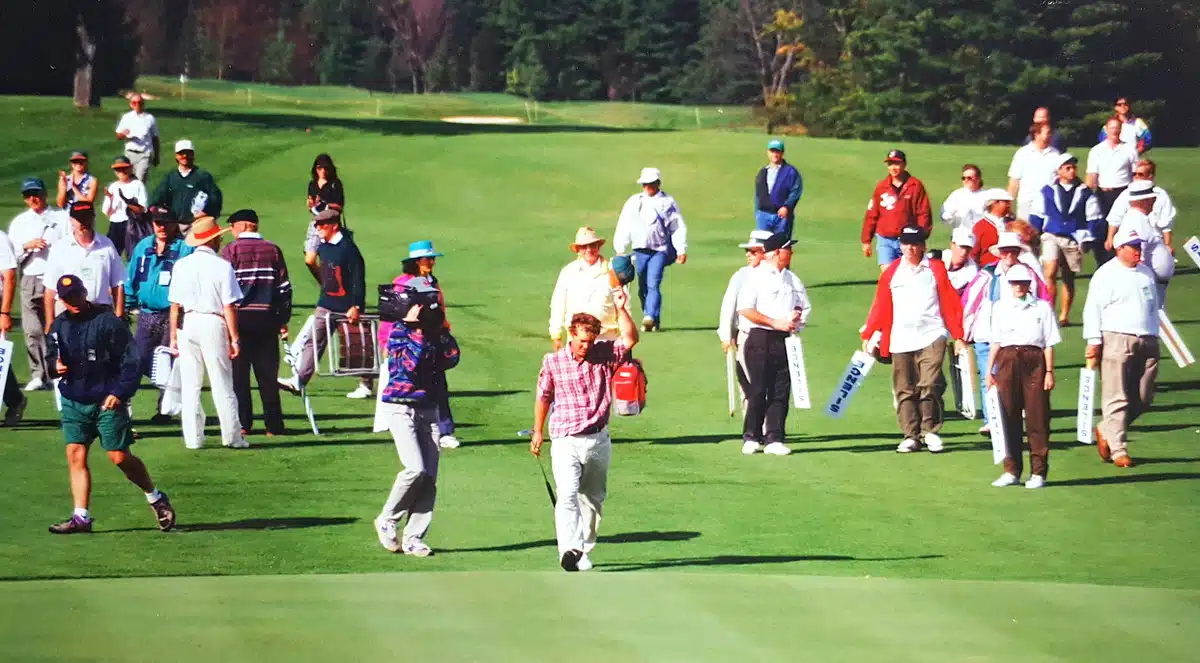
In 2024, I was the only reporter covering the 109th Ontario Women’s Amateur golf championship at London’s West Haven Golf and Country Club. That didn’t surprise me – there are so few of us covering golf, especially at the local level. And with newsrooms cash-strapped and minus staff, it’s not always feasible sending a reporter to cover a golf tourney. This was, however, a big event, in my eyes, and should have drawn more attention. In any event, what did surprise me was what would transpire on the 18th green during the post-round festivities. That week, as at any Golf Ontario-sanctioned event, interns were working on behalf of the golf governing body. Most of their duties included posting social media images and taking photos. I found it odd that the two young interns at West Haven never made the effort to say hello – I had a very visible work station in the golf club dining area, just tables away from where they also worked at their laptops. When I said hello, and stuck out my hand while introducing myself, I received nothing but a blank stare – not even a hello back. In fact, one day during the tourney I overhead one of the interns say, “That’s the reporter who’s posting social media, right there.” The second intern replied, “I don’t care.” On championship Sunday, 14-year-old Nobelle Park of Oakville claimed a wire-to-wire victory, and was standing on the green, ready for media – that’s yours truly – and the apathetic intern, camera and mic in hand. I had interviewed Nobelle multiple times that week, and had reached out to her family to say hello – they all knew me and were very happy to accommodate me for interviews. Because she was only 14, it was the right thing for me to do. Here’s the shocker: as I reached my recorder and pointed it towards Nobelle on the green on Sunday for a post-round interview, the intern said to Nobelle, “Do you feel safe with this man standing here?” For a few seconds, I stood there, stunned. And poor Nobelle. She was made to feel very uncomfortable. With my camera, recorder and very prominent press pass around my neck, this intern knew exactly who I was and why I was there. Nobelle, shyly, responded, “Yes, I am.” I looked at the intern and said, “You know I’m a reporter, right? I’ve been here all week, and I’m wearing my credentials.” I was tempted to say more, but for the sake of the young teen who had just won a major tournament, I bit my tongue. The intern, however, replied: “I know. But I need to ask.” She didn’t blink, didn’t smile – and as she had said earlier, she didn’t care, either. On Monday, I spoke in great length with Golf Ontario CEO Kyle McFarlane and Senior Director, Marketing & Communications Chris Fry in order to express my disappointment with what had transpired one day earlier. My suggestions were that in future years, interns are briefed on how to interact with media. Kyle and Chris appreciated my suggestion and apologized for the intern’s attitude and remarks. I commented that unfortunately, they wouldn’t have much interaction with reporters (see my previous comments re: lack of staff, lack of money). In fact, they agreed and said I was the first reporter at any of their events that season. Now, that surprised me, but didn’t shock me. I must say, though, that the young intern’s attitude wasn’t shocking, but her comments on the green were. FYI after she asked Nobelle a few questions for Golf Ontario social media, I then took some great photos of Nobelle (one published with this column) with the winner’s trophy, and enjoyed a nice chat with her family afterwards. This was a learning experience for me: young people today may not have any media relations skills, so I had to cut them more slack, and I said this to Kyle and Chris. The three of us had a very positive and productive chat. However, the comment on the 18th green was uncalled for, as was her general attitude toward someone who had covered golf in a credible and professional manner for almost 45 years to that point. When she left me hanging when I said hello and offered a handshake, that said it all. Interestingly enough, that summer I later spoke with a friend who ran a nearby golf tournament attended by the same intern, and he, too, noticed an air of apathy. Note: Soon, I will tackle the subject of media relations and how it is a dying art, in an upcoming edition of, On The Record with Jeffrey Reed.
Chicken Skin

After decades of working as an ink-stained scribe, few things shock me anymore. But in the early-1980s during an interview at a downtown London hotel with London’s Ted Giannoulas – The Famous Chicken – I was stunned when I came face-to-face with his feathered outfit and chicken head, hanging in a closet. It was like seeing my favourite superhero, Batman, without his mask. Fast track to August 2018, and Giannoulas also experienced a surreal moment involving his famous mascot head. “Someone had one of my chicken heads up for auction and got almost $10,000!” said a shocked yet amused Giannoulas. The Famous Chicken, now 72, is a former Londoner who lives in San Diego, the city where he hatched his comedy routine. The legend of The Famous Chicken is well known. He first worked for $2 an hour in a rudimentary chicken costume for San Diego radio station KGB in 1974. After five years and enormous success, Giannoulas wanted to grow the legend, while the radio station wanted exclusive rights to the then-called San Diego Chicken. He was fired, and was sued for trademark retention. The London native won, became a “freelance chicken,” and in July 1979 hatched at Jack Murphy Stadium at a Padres game in front of 47,000 fans. For decades, the 5’4” acrobatic, animated Giannoulas would play stadiums and arenas 260 days a year. His act has always been part Groucho Marx, part Charlie Chaplin but mostly the young boy who lived in a modest home on Essex Street in London while attending Empress Public School and later Central Collegiate. Late in his career, Giannoulas put on The Famous Chicken outfit for just dozens of games each year while enjoying life with his wife, Jane, and letting his body heal from a gruelling gig which has tested his physical fortitude for more than 40 years. Today, he occasionally puts on his famous chicken suit for special appearances. A little-known fact: The Famous Chicken was born at Eager Beaver Baseball Association (EBBA) Little League games at London’s Kensington and West Lions parks. “I would go out to the parks to watch my friends, and carry on along the sidelines,” Giannoulas said. Before his family moved to San Diego when he was 16, Giannoulas also worked the old wooden scoreboard at Labatt Park during Pontiacs’ Intercounty Baseball League contests. Oddly enough, this scribe, too, worked the scoreboard and later lived on Essex Street, just doors down from the Giannoulas home. Make no mistake about it: The Famous Chicken was a finely-tuned athlete – not just a “generic, homogenized” mascot like those who dominate the sports scene today, according to Giannoulas. Jane said when she watches her husband perform, it’s like “a child experiencing fireworks for the first time.” Without a doubt, Giannoulas aka The Famous Chicken is the best sports mascot of all-time. Second place – whomever that may be – isn’t even close. When I think back to Giannoulas’s career, I can’t help but think of that day decades ago when The Famous Chicken suit hung in a closet while I interviewed the man behind the costume. FYI you can read my 2018 interview with Ted here.
Smashed Camera

I’ve told this story before, but it’s worth repeating as it shocked me at the time, and taught me a valuable lesson. There was an incident, in the late-1980s, that still stands out amongst my all-time clashes. As I began taking photos of a family enjoying a friendly game of doubles tennis at Stronach Park in, of all places, my childhood northeast London neighbourhood, Huron Heights, the family – minus the father – bolted for their vehicle as soon as I pointed my camera their way. Dad walked quickly towards me, spoke loudly in an Eastern European language, grabbed my camera and smashed it into a thousand pieces near the court before bolting for his car. It was public space, so they were fair game, and I was writing a fluff piece, for God’s sake. But after that encounter, I sometimes asked permission to take photos – usually not, though – even though it wasn’t required. I always played it by ear, depending on the situation. Most often you don’t have time to ask permission – but when you needed to, you did. FYI that camera was an older Minolta model – I moved into a Nikon where I remained for the rest of my career as a photojournalist. I never experienced any other incident like that. Oh, I’ve had LPGA Tour golfers point at me and spew a few choice words after I took their photos (always after the point of impact, as you should). Yet they ridiculously blamed me for errant tee shots. But that’s part of the game: there will always be a love-hate relationship between athletes and sports journalists.
Bonds vs Gretzky: The Hall-of-Fame Jerk Vs The Great One

I can’t end this week’s On The Record with Jeffrey Reed without again writing about the contrasting stories of my Barry Bonds and Wayne Gretzky encounters. In case you missed them, click here for the Bonds story, and here for the Gretzky story. In a nutshell, in 1991 I was on assignment at Pittsburgh’s Three Rivers Stadium to interview Bonds, now the all-time home run king – although tainted by PED use. The Pirates PR department arranged the interview – but during my entire four days in Pittsburgh, Bonds blew me off. I was in good company, though: hundreds of sports journalists share similar stories. I did take some good photos, though. In contrast, go back a decade earlier, 1981, at the old London Gardens where I literally ran into Gretzky after the Oilers had practiced in advance of an exhibition game in Kitchener. Gretzky was not supposed to be in London – he had suffered an injury at the Canada Cup tournament. And the team was supposed to have left earlier, immediately after the practice. But while walking through the visitors’ dressing room, looking for pucks or sticks (I was only 19 at the time), I almost walked right into The Great One and his agent, ready to zoom down Highway 401 then 403 in a shiny new Porsche to visit Gretzky’s parents in Brantford. I asked for an interview. Time strapped, Gretzky didn’t dismiss me like Bonds, but instead wrote down his family’s phone number, told me to call that number in one hour and then he would do the interview. True to his word, he did – I was the only reporter to get an interview that day, although be it via telephone. But it was the kind gesture that counted. That’s why they call him, the Great One. FYI during that chat I broke the news to Gretzky that the Oilers would offer him a three-year deal for $500,000. He was less than enthusiastic about that number. The rest, as they say, is history.
Those are just a few examples of the good, the bad and the ugly I’ve encountered during a sports journalism career approaching 48 years. I always enjoy my public speaking gigs where I can recount more of those moments. Although I have retired my camera and event coverage, for the most part, I’m still clashing with sports personalities – almost always for no good reason other than they can’t handle the truth, and because I don’t write fluff pieces: they’re not used to it, given the fact few sports reporters write as I do at the local level, and because media numbers are dwindling. But hey, that’s part of the job. Otherwise, just stick me in a PR job where I can post happy news on Instagram all-day long. On that note, when we return from an overdue vacation, LondonOntarioSports.com will publish the next On The Record with Jeffrey Reed, focusing on the dying art of media relations.
Enjoy the rest of the summer, and we’ll see you back here on September 19.
–30–
Award-winning writer and broadcaster Jeffrey Reed has written and talked about sports for a local and national audience since 1980. A three-time author, Reed is also a disabled athlete who coached and pitched with the London Majors Baseball Club, and who worked as a brand ambassador and golf teaching pro for 14 years. He has been nominated for the London Sports Hall of Fame. Reach Jeffrey at jeff@londonontariosports.com.