On The Record, with Jeffrey Reed
May 23, 2026
Barry Bonds Hall Of Fame Jerk

One of the many hats I’ve worn since 1980 as a freelance sports journalist is Major League Baseball reporter. In fact, covering the big leagues has been my most enjoyable gig. Ever since I mouthed my first word – my parents told me it was, ‘ball’ – baseball has run threw my veins, as a fan, a player, and a writer and broadcaster.
Growing up in London, Ontario – a city still with a small-town attitude and inferiority complex (that’s a story for another day) – I was a Pittsburgh Pirates fan. I mentioned this in a sports bar a few years ago, only to be ridiculed by a drunk who quipped, “Pirates fan? What the hell: are you stuck in the 1970s?” Indeed, when the Bucs, led by Willie Stargell, Dave Parker, Kent Tekulve and the likes, captured the 1979 World Series, I thought, as a 17-year-old, that more victories in the Fall Classic would soon follow. How wrong I was.
Here we are, 47 years later, and my beloved Pirates are still seeking their sixth World Series victory. Pittsburgh came close, in 1992, and were, in fact, just one strike away from beating the Atlanta Braves for the National League pennant. But Francisco Cabrera, of all people, hit a two-out, pinch hit single to score David Justice and former Pirate Sid Bream – bad legs and all – to send Atlanta to the Series versus eventual winners, the Toronto Blue Jays.
It took me 45 years until I re-watched that fateful pinch hit on DVD – it’s still painful. Of course, that ground ball was hit into shallow left field to none other than Barry Bonds, who made a horrible throw to catcher Mike “Spanky” LaValliere. I’m still not over that game – and never will be. Then again, my father was a diehard New York Yankees fan, and he never got over the fact his son was a Pirates fan after the Bucs beat the Bronx Bombers in underdog fashion two years before I was born, in 1960.

Barry Bonds, Three Rivers Stadium, Pittsburgh 1991. Photo: Jeffrey Reed/LondonOntarioSports.com.
One year prior to 1992, I was on assignment from July 15-17 to cover the Pirates and the Houston Astros during a three-game series. It was my first visit to Three Rivers Stadium – a cold, generic concrete bowl which was imploded on February 11, 2001 and gave way to beautiful PNC Park. Nevertheless, Three Rivers held a lot of memories for me. The Pirates won games one and two of that series, 8-0 and 6-4, then lost the final game, 10-2.
En route from a series in Cincinnati, Pirates skipper Jim Leyland experienced severe chest pains and the Pirates’ USAir Flight was diverted to Columbus, Ohio and landed so Leyland could be rushed to Mount Carmel East Hospital. As it turned out, Leyland – a nervous, high-strung chain smoker and eventual Hall of Fame manager – had an anxiety attack, not a heart attack. The Bucs had just swept four straight against the Reds, but that didn’t ease Leyland’s pain at all. Perhaps much of his anxiety stemmed from coaching Bonds, who, with apologies to Ty Cobb, may have been the meanest, most high-maintenance player ever to suit up for a big league ballclub.
After the Pirates beat the Astros 8-0 on July 15, I was in Leyland’s office, interviewing him about the game and about his health. During our banter, in rushed Bonds and his best friend on the Pirates ballclub, outfielder Bobby Bonilla, who carried in a large plate full of fruit. Unlike Leyland and Bonds, the skipper and Bonilla enjoyed a father-son type of relationship. Bonilla could be surly (later, as a Met, dealing with the New York reporters, he was almost as mean as Bonds), but with fruit in hand, Bonilla quipped, “You have to eat healthy, skip, this is what you’re eating for now on, Take care of yourself. We need you around!” As soon as he and Bonds had rushed in, they then disappeared, laughing, back to their lockers in the Pirates clubhouse.
That spring saw the infamous verbal sparring match between Bonds and Leyland, who told the prima donna Bonds in an expletive-filled dressing down that he was the “fucking manager of the fucking team,” and that if Bonds didn’t want to be there, he could “get his fucking ass” out of the Pirates Grapefruit League camp in Bradenton, Florida. Word was, the entire Pirates roster cheered privately when the biggest ass in baseball was finally taken to task.
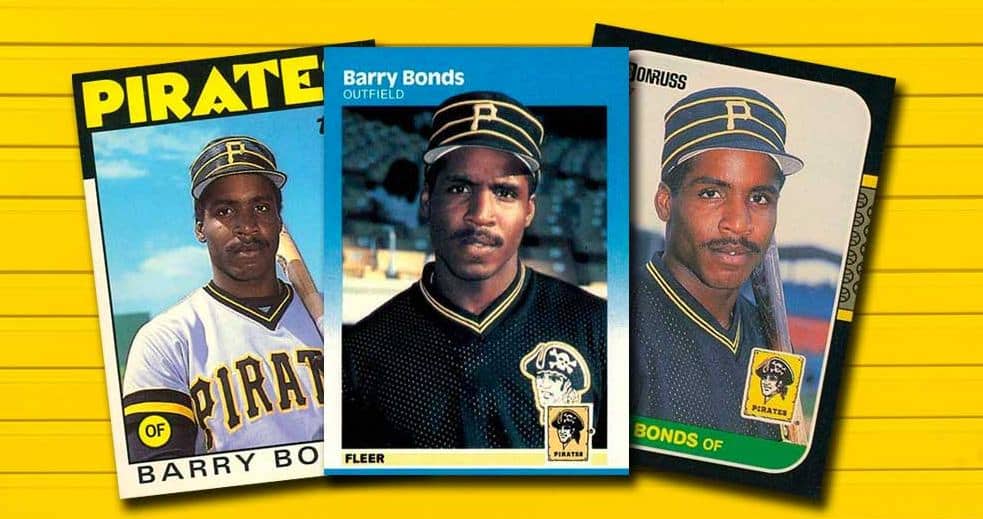
Much has been written and spoken about Bonds, his records – most notably most career home runs (762), most single-season home runs (73 in 2001) and career walks (2,558) – and his blatant use of performance enhancing drugs. Anyone with even poor vision could see the difference between the Pittsburgh Pirates version of Bonds – who was already a five-tool player and destined for the Hall of Fame – and the inflated San Francisco Giants version – Bonds 2.0.

Barry Bonds talkin’ baseball with Houston Astros manager Art Howe, Three Rivers Stadium 1991. Photo: Jeffrey Reed/LondonOntarioSports.com.
My Bonds encounter occurred during the outfielder’s more slender era, but even then his power at the plate amazed me. I spent three days around the cage during Pirates batting practice and saw Bonds, with just the flick of a wrist, pound one ball after another deep into the right field power alley and into the bleachers at Three Rivers Stadium.
My assignment during those three days in Pittsburgh was to interview in-depth the superstar ballplayer who, in his sixth season and reigning National League MVP, was on the cusp of all-time superstardom. Prior to making the seven-and-a-half hour drive to beautiful downtown Pittsburgh, I had spoken with the club’s media relations team who had ensured me that Bonds would cooperate and that I would get my story. I doubled as a freelance photographer those three days, too, as I have during most of my career, and literally had my hands full.
On Monday, July 15, 1991 the Pirates media relations folks introduced me to Bonds as the Pirates stepped out onto the horrible – and sometimes career-ending – artificial turf at Three Rivers. Of course, Bonds didn’t shake my hand, nor did he look me in the eye. His only words were, “No problem. We’ll talk after I hit.” Later, he told me, “Sorry, dude, not today. Come back tomorrow.”
I did, of course, and again got the same song and dance from Bonds. I told him I was only in Pittsburgh for one more game, but his mind and focus had already left me a long time ago. On Wednesday, with a nasty grin, Bonds told me, “Sorry, dude, not going to happen. I don’t have time.” That prick, I muttered to myself. The Pirates PR folks shrunk and said how sorry they were. I got the feeling this act had become all too familiar with them. Hundreds of other reporters, from what I have read and heard, were privy to the same treatment from Bonds.
I didn’t get the interview, but I did stick my camera lens in Bonds’ face every moment I had during BP before that third game. Surprisingly, he didn’t say a word to me. Perhaps that was his way of saying sorry, but I doubt it. The only time I saw Bonds smile was when he enjoyed some pre-game banter with Astros manager Art Howe, who had played briefly with Bonds’ father, the oft-traded Bobby Bonds. Howe, by the way, went out of his way to chat with this scribe. His betrayal in the movie, Moneyball, was way offside – Howe was very much liked within the baseball circle.
FYI Bonds was not the most famous person I’ve encountered during my career. I’ve interviewed Prince Philip, and legendary actor Mickey Rooney, for example. I’ve crossed paths with thousands of ballplayers, NHL players, etc. but Barry Bonds was without a doubt the biggest jerk I’ve come face to face with on a big league diamond.
Finally, let me say that I believe Bonds deserves to be inducted into the Hall of Fame. However, the entire era in which he starred must have an asterisk attached. Other cheaters, including Ivan “Pudge” Rodriguez, Jeff Bagwell and Ivan Rodriguez – all of whom I’ve interviewed – are enshrined in the Hall.
The difference, ironically, is that Bonds broke those sacred records, and for that he may never be forgiven. Most importantly, he was a jerk, and most will never forgive him for that.
–30–

On The Record is published every Saturday at LondonOntarioSports.com. Jeffrey Reed is Southwestern Ontario’s senior sports journalist, with roots dating back to 1980. A three-time author, Reed penned, EBBA 40 Years of Baseball (1994) and, The Canadian Seniors’ Golf Association, Celebrating 100 Years of Seniors Golf 1918-2018 (2018). Reach him at jeff@londonontariosports.com.