
On The Record with Jeffrey Reed
July 18, 2026
The Fascinating History Of The Eager Beavers
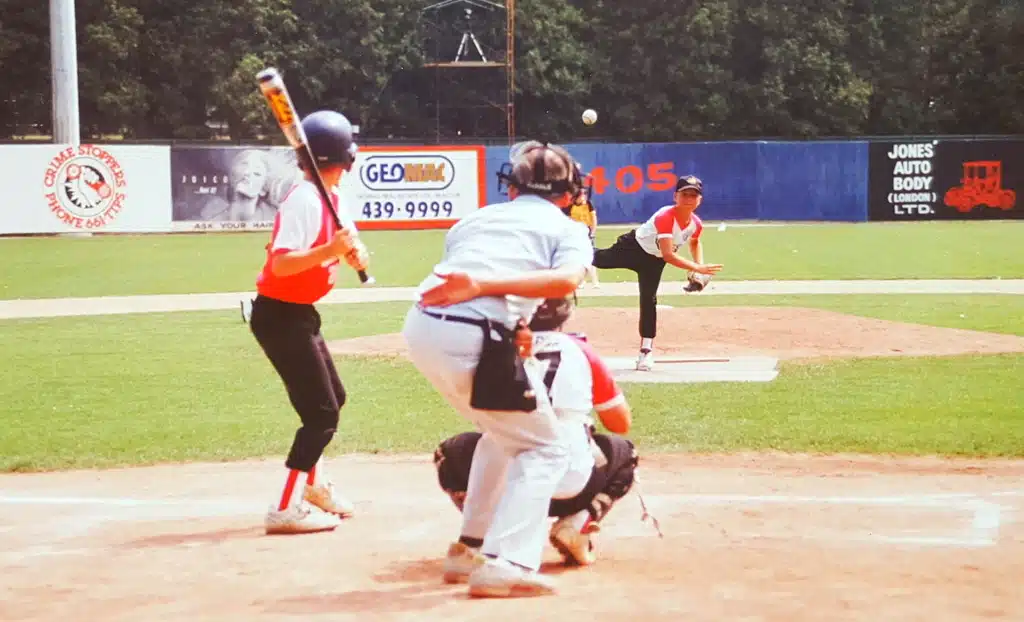
Above Photo: EBBA All-Star Day at Labatt Park 1992. Photo by Jeffrey Reed/LondonOntarioSports.com.
When I mention to people that I am the author of, EBBA 40 Years of Baseball (1994) – London’s very first baseball history book, chronicling the first 40 years of the Eager Beaver Baseball Association – the first thing they often do is laugh and ask, “Eager Beavers?” For some reason – and I’ll leave that to your imagination – a lot of people love to say, Eager Beavers.
It is, in fact, a non-typical name for a minor sports organization. Most are named, for example, South London Baseball Association, or Strathroy Minor Baseball Association. London’s Red Circle Hockey Club would be another non-typical name. But nothing beats the Eager Beaver Baseball Association (EBBA) moniker for instant name recognition.
EBBA is historically significant. Established by a small group of local baseball enthusiasts in 1955, it is London’s original fully-organized minor sports association, and one of Canada’s oldest minor baseball groups. The people who have played a role in its founding and its continuation for 72nd season in 2026 are quite often fascinating characters worthy of their own biographies.
Yet when I embarked on this project way back in 1993, I had no idea just how fascinating EBBA’s history really was. It didn’t take me long, though, to discover some until-then unknown or forgotten tales from EBBA’s history – and in a few cases, I was shocked by what I discovered.
Now, this was before the advent of the Internet, kids, so you can imagine the hours – more than a year, in fact – that I spent scrolling through and squinting at microfiche at the London Public Library. I also interviewed hundreds of people who recounted their own stories about EBBA since its charter season in ’55. I took photos, too; read books and yearbooks; and did everything but visit the graves of baseball legends Babe Ruth and Ty Cobb – but I did, very surprisingly, find a connection between The Babe, the Georgia Peach and EBBA. More on that later.

1970 EBBA Pee Wee champion McMahen Park Orioles. Writer Jeffrey Reed is the bat boy in the front row. Coaches are (L-R) his father, Ken Reed, uncle Bob Reed and uncle Don Jury.
How did my book materialize? My family has a long history with EBBA. My maternal uncles, twins Don and Larry Jury, played EBBA baseball for the Central London Lions Braves during that inaugural ’55 season. Along with my father, Ken Reed, his brother, my uncle Bob Reed, and my aunt’s husband, Tom Jarvis, Don coached and managed EBBA ballclubs. I began my EBBA connection as a 7-year-old bat boy with the McMahen Park Pee Wee Orioles in 1969, then played from Tyke through Bantam with EBBA before eventually coaching and pitching with the London Majors of the semi-pro Intercounty Baseball League. Even my sister, Angela, took a turn as bat ‘person’ with the Orioles.
Baseball history has also been a passion of mine. So, as EBBA was about to celebrate its 40th anniversary – or so I thought – I contacted the league executive about writing a history book. Surprisingly, not only did the EBBA office have no historical documents or photos of any kind, but also the folks then running the show had no idea that EBBA was founded in 1955. The founding date held somewhat of a mysterious aura about it – some said it was founded in the 1940s, others said 1954, while others even said it had only started in the early-1960s.

Jeffrey Reed presents additional copies of his 1994-published book, EBBA 40 Years of Baseball, to the London Public Library in 2016.
I had always been told during my Little League days that EBBA’s first season was 1954. I was told wrong. But with that date in mind, 1994 would have marked the league’s 40th anniversary. Then, through my first day of research, I discovered that EBBA, in fact, played its charter season in 1955. That meant 1994 would be the league’s 40th season, not 40th anniversary. There was some debate as to whether or not we should hold off on the book, originally published by EBBA, until 1995. But in the end, we decided to go ahead with the project to mark the 40th season.
That didn’t mean that all went smoothly, though. The infighting – nasty politics – amongst some of the league executives was unsettling for me as author. I received late-night calls demanding that some people be left out of the book, and that others receive more ink than others. One board member even knocked on my door with such demands. With risk of putting the project in jeopardy, I followed my gut and ignored the bullshit noise that surrounded me as I put my creative talents to work.
In the end, EBBA 40 Years of Baseball has seen two printing runs totaling 10,000 books, and it is available at the London Public Library.
To me, EBBA was an important part of local sports history. Little did I know, though, that some of the biggest names in the game – Baseball Hall of Fame members included – played a part in the founding of London’s original minor sports organization.
Frank Colman, Gordon Berryhill, Babe Ruth and Ty Cobb

Frank Colman (striped shirt), EBBA treasurer Alex Park and members of the Eager Beaverettes fundraisers in 1955. Photo: London Free Press, from EBBA 40 Years of Baseball
Until I began researching for, EBBA 40 Years of Baseball, it was widely considered that former MLB player and London Majors legend Frank Colman had founded EBBA. But it was London baseball enthusiast Gordon Berryhill who was the founder and most instrumental person during EBBA’s early years. Discovering that fact was a ‘holy shit’ moment! No one seemed to know who this Berryhill fellow was, until then. And when I stumbled across the fact that Berryhill was a close friend of both Babe Ruth and Ty Cobb, well, you can just imagine how the needle on the holy shit metre fell right off the scale.

Gordon Berryhill (top, second from left) with Babe Ruth (far right) and members of the Boston Red Sox. Photo courtesy Berryhill family from EBBA 40 Years of Baseball.
For years, I had to battle EBBA board members who, despite my research discovery, had chosen to ignore Berryhill and carry on the lie that Colman was the founding father. But the truth always wins out, and Berryhill got his day – literally.
In 1984, the annual EBBA Labatt Park All-Star Day (also known as Labatt Day and Eager Beaver Baseball Day over the years since 1955) was renamed, Frank Colman Day, honouring one of EBBA’s important league founders – there were scores of founding members. You can Google more of Colman’s baseball career stats and milestones, but in 1942 he signed as an outfielder with the Pittsburgh Pirates, and played in the outfield and at first base for the Bucs and later outfield for the New York Yankees. In ’55, the Londoner purchased the London Majors from Clare Van Horne and became owner/manger/player.
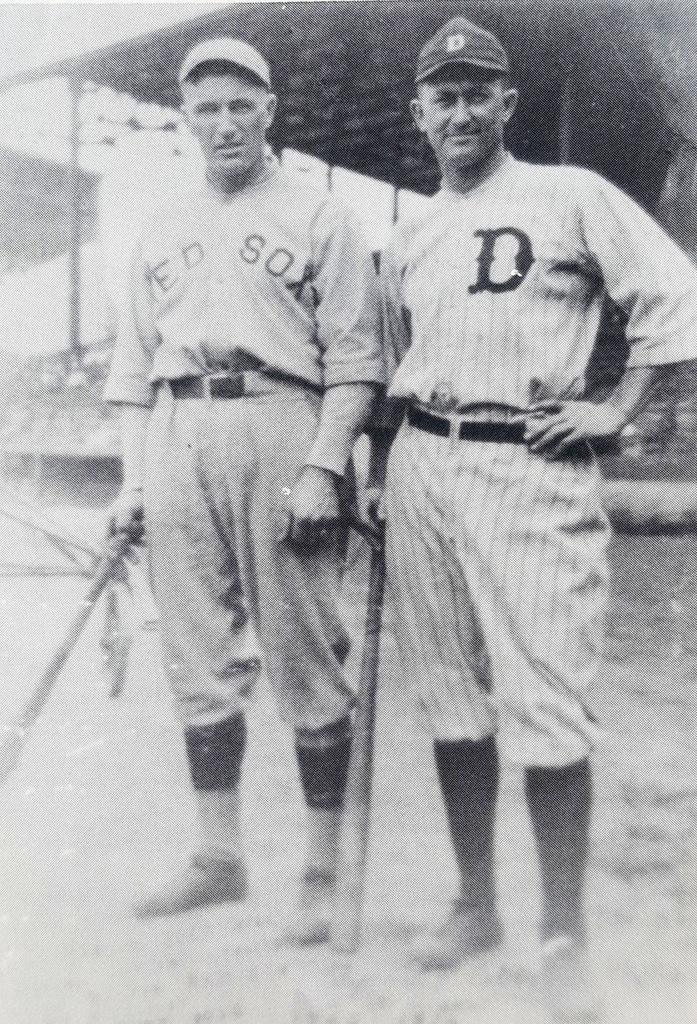
Gordon Berryhill and Ty Cobb. Photo courtesy Berryhill family from EBBA 40 Years of Baseball.
Certainly, Colman gave the fledgling EBBA instant credibility and guidance. But it was well-known (back then) local baseball fanatic Gordon Berryhill who founded the minor sports group. Born in Middlesex County in 1894, Berryhill was a World War I veteran and career military man who was wounded during battle in England – where, oddly enough, he was first introduced to baseball.
Not a pro but skilled just the same, Berryhill began to devote his entire attention to the game of baseball. Legend has it that he played some minor league ball in the U.S., but no records have been discovered. He did, however, earn a tryout with the Boston Red Sox in 1919 when he befriended none other than the Sultan of Swat: Babe Ruth. Also during that spring training, he befriended Ty Cobb. Berryhill’s daughter, Betty, of Greenville, North Carolina, spoke in great length with me about her father’s deep friendship with the hall of fame duo which continued for many years, and how they helped instill in him an even deeper love of the game. Incredible find for my book!
A sandlot coach in London, Berryhill would eventually build his own Field of Dreams: a ball diamond on his residential property at the corner of Second and Oxford streets in London. Kids from all over the city would walk or ride their bikes to Berryhill’s ball diamond where they could play baseball all day long. Berryhill lived there, and each day would put out bats, balls and gloves for the children to use – he even supplied big buckets of peanut butter and jam, and bottles of Coca Cola. If an older gentleman did that today, parents would warn their kids about the weirdo up the street. Thank God this was the 1950s.

EBBA Opening Day June 4, 1955. Photo London Free Press from EBBA 40 Years of Baseball.
Eventually, Berryhill dreamt of forming a city-wide baseball league for local youngsters – not informal games and leagues like the City was already running through its own sandlot leagues, but a truly organized minor sports association: the first of any kind for the rapidly-growing Forest City. The rest, as they say, is history, as EBBA – with many notable baseball folks involved through countless late-night meetings – played its Opening Day on Saturday, June 4, 1955. The first meeting was held on February 1, 1955 – incredible that the league played its first games just four months later.
An aside: the family living next door to my mother and uncles on William Street during the 1950s was none other than the Berryhill family, relatives of Gordon. You can’t make this stuff up. Thanks to my research, Berryhill, who died in 1988, is now recognized by EBBA with its annual Gordon Berryhill Volunteer Award, given to a recipient who volunteers services and endless time to EBBA.
Bob Ferguson and Why Eager Beavers?

Bob Ferguson
“Who else would think of the name, ‘Eager Beaver,’ other than a sportswriter?” said Bob Ferguson during my book research in 1993. In fact, it was Ferguson who coined the phrase, Eager Beaver Baseball Association. He said, “I gave them their name. They were batting around different names (at founders’ meetings), coming up with all kinds of stuff. I said, why not call them Eager Beavers? (The kids) are all eager beavers. And it stuck!
In the summer of ’55, Ferguson was a 24-year-old reporter with The London Free Press specializing in baseball. A Windsor native, Ferguson joined the Freeps in 1952. Colman recruited him to help form what would become EBBA. The sportswriter, who later became a good friend of mine and a strong supporter of my own writing, left London in 1967 to write for the Ottawa Citizen. He died in November 2014 at age 83.
No other colleague has helped shape my career in sports writing as did Ferguson. In 1993 and early-1994, as I researched for my book, Ferguson and I spoke almost daily. It was then that I learned of Ferguson’s deep love of Canadian sports. After all, Fergie is author of, Who’s Who in Canadian Sport (first published in 1977), and a member of the Ottawa Sports Hall of Fame.
If not for Ferguson, EBBA 40 Years of Baseball would not have come to fruition. Not only does my book rely heavily on Ferguson’s original stories which appeared in the Freeps in 1955, but it also stems from numerous chats and get-togethers with Fergie during my research. I knew instantly that this man was not only a legendary sports journalist, but even more importantly one who shared with me a deep love of Canadian sports history.
Shortly before he died, Ferguson recalled his own youth. “I was an average athlete. Probably a little sub-par!” he said, with that big laugh of his. “But I had the interest in writing. So I decided, what the heck, I’ll give it a try.”
Fergie – as the saying goes – was not cheated by life. He was a professional singer and a bank teller before he joined the Free Press newsroom. No dust ever gathered on Fergie – he was also a baseball commentator for CFPL radio, and Intercounty Baseball League statistician. I followed in his footsteps as a local radio and TV baseball broadcaster, and founder of the Intercounty’s media relations office. Fergie was general manager of the Ivanhoe Curling Club 1964-66 and GM of Strathroy Golf and Country Club in ’66 before leaving for the Citizen in ‘67. He retired in 1996.

1964 London Pontiacs
“I’ve probably covered every sport, played by the best and the worst,” recalled Fergie late in life, “and sometimes the ones played by the worst were the best. They were genuine. It was mostly kids, and you knew they were giving it everything they had. It was a lot of fun and it was a good life.”
Ferguson was owner-general manager of the IBL’s London Pontiacs (now London Majors) in 1963-64. “I was the league statistician,” said Ferguson. “The (London) team owner decided without telling anybody that he wasn’t going to field a team this particular year. I’m at the meeting, and it’s time to put in the entry fee, and there’s no London representative. I said, there’s something wrong here! I put in the entry fee – it cost me $50! So I owned the franchise. I got all the players together and we formed a share-the-wealth organization, if there was any – and there wasn’t! We went to London Motor products and became the London Pontiacs.”
Constantly during my year of research, Fergie was on the phone with me, encouraging me to finish the job, and reminding me what a great thing it was to remember our past. I’ll never forget Bob Ferguson for his kindness, generosity and his true love of Canadian sports.
The League Almost Folded
While London’s Intercounty Baseball League franchise almost folded, if not for Ferguson, in 1963, EBBA almost died during the 1970s due to economic issues – that’s a kind way of saying, missing money. During this time, I was a young ballplayer, dressed in my Little League uni, who solicited funds in front of beer and liquor stores during Tag Day. I was listening in on meeting with EBBA board members when money was counted at the end of the day, and I still remember overhearing talk of money problems. In fact, my uncle Don Jury, a local Justice of the Peace, played an important role in righting the ship.

1975 Pee Wee Orioles pennant-winning squad. The writer, team MVP and all-star, is last player, top right.
In 1970, things appeared to be running smoothly for EBBA. A strong Pee Wee Orioles team coached by my uncles Don and Bob, and my father, drew large crowds at McMahen Park as we – I was the bat boy – went undefeated en route to a championship victory. Tryouts back then would see up to 80 boys ages 12 and 13 fight for a spot on the squad. Saturday morning practices ran from 8 a.m. to 12 noon – try telling that to today’s pampered youth. But we were always awarded with cases of Pepsi Cola or Pop Shoppe soda afterwards. Who remembers peeling back the Pepsi bottle cap liners to reveal poker cards, which could win you prizes? Pop bottle drives were major team fundraisers which helped pay for bus trips to Tiger Stadium. Great times!
Yet just a few years later, a lack of funds almost forced EBBA to call it quits. Although I did not chronicle this in my book, there was much talk amongst my uncle and father of money mysteriously disappearing from the league treasury. But EBBA President 1971-73 Doug Stinson spent more than $100 each week of his own money to keep the league afloat. The board got behind him and saved the day.
Yet by the end of the decade, again EBBA suffered major money problems – the handling of league funds had become a thorn in the side of the minor sports group. I did not turn up any dirt on this scandal nor the previous money problem during my research. But I did learn that EBBA leaned on legal advice in 1979 and soon afterwards incorporated.
The Famous Chicken Got His Start With EBBA

The Famous Chicken, Londoner Ted Giannoulis
I can’t end this edition of, On The Record with Jeffrey Reed, without mentioning Londoner Ted Giannoulas aka The Famous Chicken – the GOAT of sports mascots. Long before he entertained fans at MLB stadiums and countless others on television, and at thousands of sporting events around the globe, Ted honed skills as a sideline clown at – you guessed it – EBBA games.
The Famous Chicken earned his feathers clowning around behind the benches at EBBA games at Kensington and West Lions parks. He told me, “I never felt I had the ability to play. I would go out to the parks and watch my friends, carry on along the sidelines. I would go watch the London Pontiacs and Diamonds at Labatt Park, and a lot of times handle the scoreboard.” I worked the wooden scoreboard, too, during my teenage years. In fact, during my early-20s, I lived next door to where Giannoulas had lived on Essex Street in London. And get this: one of my earlier mentors, freelance writer Herman Goodden, lives in the same house Giannoulas lived in on Rogers Ave., in the shadows of Labatt Park. Again, you can’t make this stuff up, kids.
Giannoulas and his family moved to San Diego when he was 16. The rest is history, as the former Londoner became, in his words, the “fuzzy Groucho Marx.”

With apologies to the Famous Chicken, these are all just a few nuggets from, EBBA 40 Years of Baseball. I still have a few copies available, if you are interested in reading more about London’s original minor sports association. Just let me know – first come, first served. Or, you can visit the London Public Library for a copy.
Recognizing EBBA’s importance to local sports history has been one of my passions and most important projects throughout my entire career. I hope this column has played a part in rightfully shining the spotlight on the minor sports organization.
Finally, I have to add, in addition to playing most of my minor baseball in the EBBA system and writing the association’s history book – discovering the gems I have written about in this column – I managed the 1991 EBBA Bantam Giants at West Lions Park to a pennant championship. The boys presented me with the game ball after that victory, and it sits atop my office desk. It’s a special piece of history from a historic London sports association.
–30–
On The Record is published every Saturday at LondonOntarioSports.com. Jeffrey Reed is Southwestern Ontario’s senior sports journalist, with roots dating back to 1980. A three-time author, Reed penned, EBBA 40 Years of Baseball (1994) and, The Canadian Seniors’ Golf Association, Celebrating 100 Years of Seniors Golf 1918-2018 (2018). Reach him at jeff@londonontariosports.com.