


Athlete For Life
Most Former Athletes Over 40 Train The Same Way All Year
by Jeremy Hudson, Athlete For Life
Here’s the Season Template I use – built around your job, your kids and your holidays – instead of training the same way all year.
Your training used to revolve around the season, and if you want to train like an athlete, that shouldn’t change.
You need something to train for. A stretch of training with a start, a build-up, and a day you peak for — one you can circle on the calendar.
Let the number of sports you play dictate how many seasons you get. Play one, you get one. Play two, you get two. Play none, and you still get one, because a retest becomes the thing you’re building toward.
Making a season fit your real life — around a job, kids, and two weeks at the lake — comes down to one idea:
You’re always training everything. Only the ratios change.
That’s a different way to train than the one you grew up with. And after 40, it’s the better one.
Why Ratios Beat the Blocks You Grew Up On
When I played baseball, I trained in blocks. The off-season started with what’s called anatomical adaptation — getting my muscles, tendons, and ligaments ready to train hard again, and building muscle along the way. Then a block to convert that size into maximum strength. Then a block to convert that strength into power. Then the in-season maintenance phase.
That system won’t work for me now — not for someone over 40 — because each phase’s progress came at the expense of the others. Gain strength, lose size and speed. Gain power, lose strength and size. It worked great, but only because I could dedicate much more time to training.
We don’t have that luxury anymore, and that changes the game. Because now, whatever we stop training fades.
Think of it like ice. Strength is a big ice block — it takes a long time to melt down. Power is a small cube, gone by the end of your vacation. So if you train one quality at a time, something is always being lost.
This isn’t just a problem midlife weekend warriors have. Even with elite professional athletes, the approach changes between 25 and 35. The separated-block focus that built the 25-year-old stops working for the 35-year-old, so the training becomes more inclusive: every quality trained at the same time, in different amounts. The same logic applies to you now.
And even though most of us used to train in blocks, we don’t anymore. We just train the same way all year. I’ve watched people in their 60s and 70s walk into the gym with the same workout card they’ve been carrying for five or ten years — same exercises, same order, roughly the same weights, still writing it all down. Nothing ever gets emphasized. Your body has no reason to change.
Same workout, same body? Not after 40. Same workout, slow decline.
Using ratios fixes both problems: the blocks that let things fade, and the sameness that lets things decline. Because every phase trains all four qualities — muscle, strength, power, and conditioning — nothing gets dropped; a vacation just lowers the dose. And because the emphasis keeps changing, the stimulus keeps changing, so you keep improving. It’s also a lot more fun: every phase has something fast, something heavy, some muscle-building, and some conditioning in it.
After 27 years of writing training programs, this is how I coach adult athletes, because nothing else compares to the results it produces. One of my current clients is 80. In August, her max was 2 push-ups with her hands 13 inches off the floor. This week she did 2 with her hands at 9 inches — four inches closer to the ground on a lift where every inch counts. She also maxed out the 150-pound stack on the two-arm cable row, so we moved her to one arm; she’s now rowing 90 pounds single-arm.
That’s the system working. And now it’s yours.
The Season Template
One season is one run through the cycle, from the Capacity Phase to the Retest.
Every cycle starts with the Capacity Phase: 4 to 12 weeks that build your movement, your muscle, and your conditioning — whichever one needs it most. How long depends on how trained you are and how much you need to add: more muscle, better movement, or more conditioning. Newer to lifting, or with a lot to build? Stay toward the long end. Years under the bar and already moving well? Go shorter.
Then the cycle runs, and one optional phase can drop in whenever you need it:
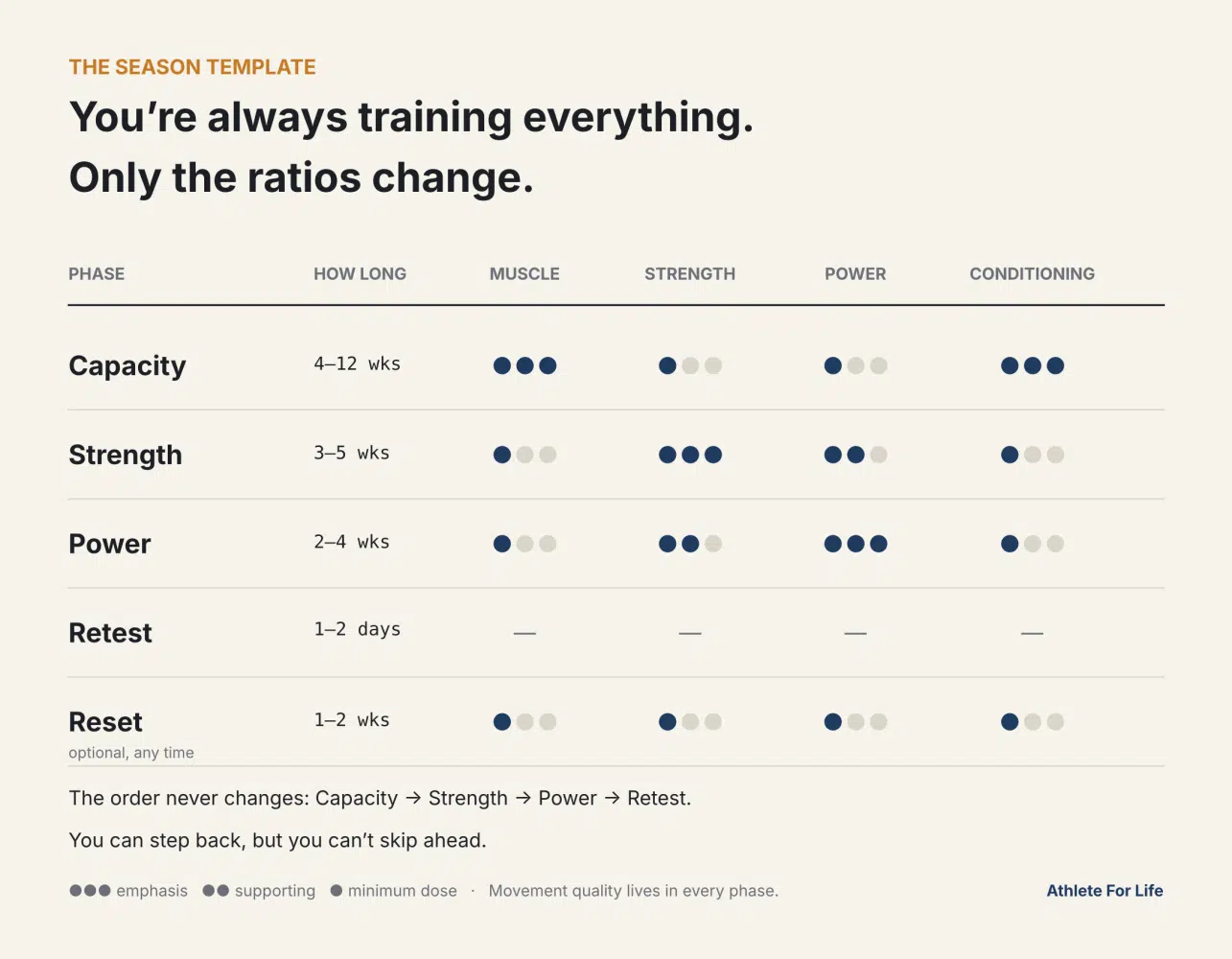
Movement quality isn’t a column because it’s never optional — it’s in every phase, every warm-up, and it’s what the Capacity Phase fixes first, so you have something to build strength and power on.
The Capacity Phase builds your movement, muscle, and conditioning, and it’s the hardest stretch by total work. The Strength Phase goes heavy. The Power Phase drops the volume and lets speed and explosiveness lead. The Retest comes right after the Power Phase, because that’s when you’re sharpest; test at any other point and the numbers will likely come in low. A retest can be one day, two, or spread across a week — and a retest week is a light week by design, so it doubles as a Reset.
So the order never changes: Capacity, Strength, Power, Retest — because power is built on strength, and strength is built on muscle. You can step back, but you can’t skip ahead.
Notice something. These are the same phases I ran as a ballplayer — same emphasis, same order. Anatomical adaptation just goes by Capacity now. The difference is that nothing gets dropped. The emphasis moves while the other qualities ride along.
A season can also run Capacity, Strength, and Power twice before you retest. That’s useful when the season is long or you want more time to build. Just make sure the retest comes right after a Power Phase.
A Reset isn’t required. It’s usually one week, two at most, and it does exactly what the name says — anywhere from doing nothing at all to running the minimum doses. Add it any time a holiday, a trip, or a heavy stretch of life calls for it.
The same template fits whatever you play:
No sport: run the cycle, retest, and go around again. The retest is your season.
One sport: time it so the Power Phase lands right before your sport season starts — that phase is your final confirmation that you’re ready. Then the sport season takes over, and you train at minimum doses until the playoffs.
Two sports: run a shorter cycle in each gap between sport seasons, and hold minimum doses through both.
When you start depends on when you need to be ready. Count backward from the day you peak for: if hockey starts in October, get going by June or July, because that gives you three to four months to build. No sport? Pick your retest date and count back from that. For most, September is a natural place to begin, because the kids are back in school and your calendar has room in it again.
The honest trade for sport players: you give up some training progress for your sport. The biggest risk is a long season wearing down what you built. The template’s job is to keep that loss as small as possible.
The Shape Bends. That’s the Point.
What does this look like when you’ve got a job, kids, and a family trip every August?
It looks flexible.
The Season Template is the shape I use, not a schedule to obey. Phases stretch or shrink. A four-week phase becomes six because a tournament weekend and a sick kid ate two of them — or it becomes three because you’re ready to move on. That’s fine.
Most people train three days a week. When something comes up and a session gets missed, keep your two main days and drop the less important one, which is usually the middle day of the three.
Some weeks, training wins — it’s retest week, so you skip the Saturday thing, and that’s okay. Other weeks the kids’ stuff wins, and that’s okay too. You’re allowed to have a life. The plan is built to absorb it.
A plan that bends around your life is a plan you’ll still be running in June.
Turning the Dials
Because everything is always in the program, you get to steer it as you like.
Want more size? Stay in the Capacity Phase longer, or go back to it.
Need to be stronger in a lift or a movement that’s holding you back? Run a Strength Phase and put that lift at the center of it.
Just booked a trip eight weeks out and want to look your best? Shift the dials toward conditioning and muscle for those eight weeks, then let the trip be your Reset.
Here’s a real one. A client of mine just finished a full summer season in a power sport, and is now running Spartan races through the fall. Those are polar opposites in how you prepare. We started with a six-week Capacity Phase: the first two weeks as a transition, the next four building conditioning. Now we’re on track for peak shape — just by adjusting the dials.
Want to step back before you move forward? Go ahead. Here’s what a real season might look like for you, 32 weeks start to finish:
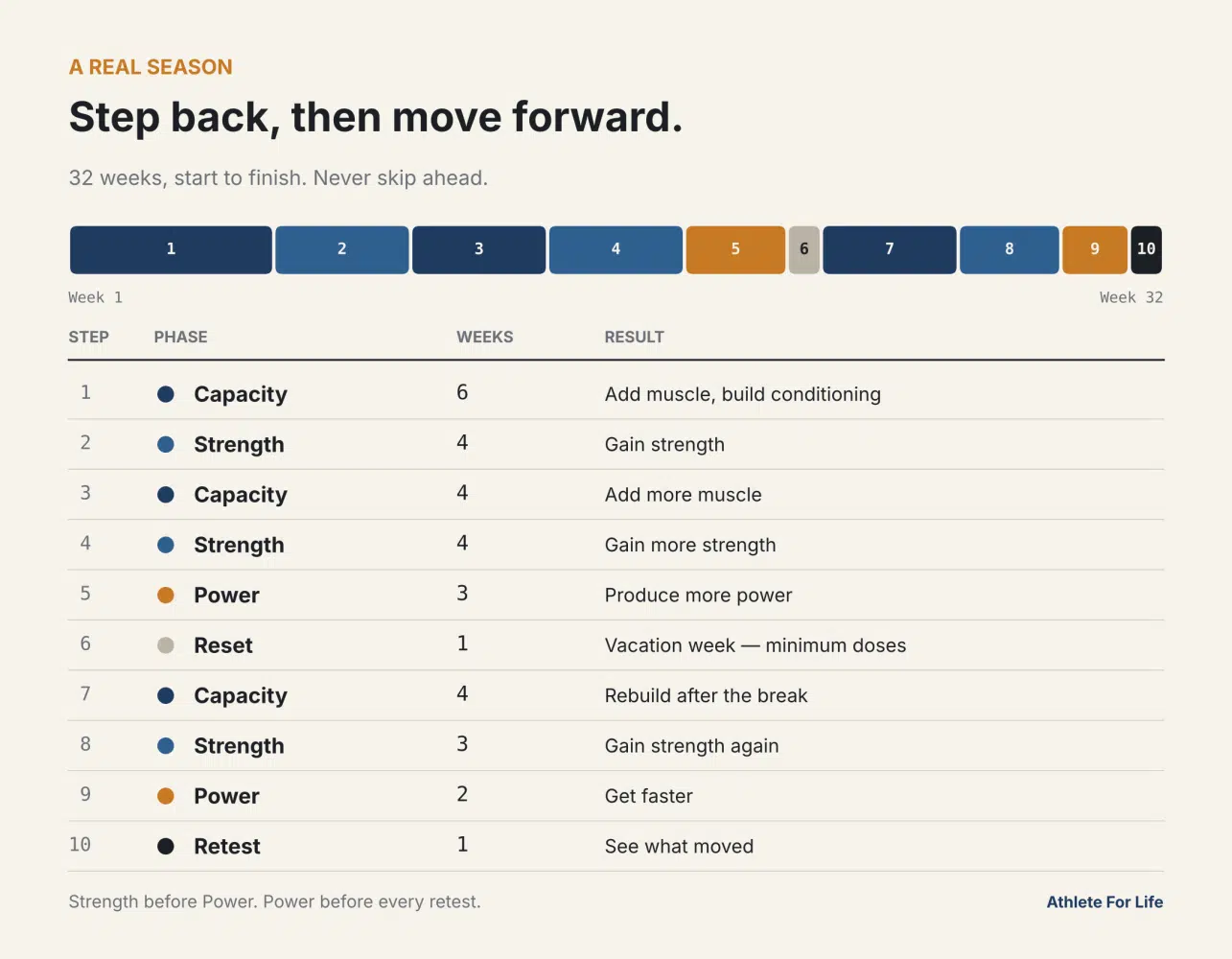
That works, because none of the four qualities ever left. The only rule: never skip ahead. Strength before Power, and Power before every retest.
If you’re seriously training to perform — a competition, a tryout, a big event — run the phases straight through. Everyone else: stepping back when you want more size, more strength, or a breather is completely okay. That’s the pliability. And honestly, that’s what makes it fun.
The Minimum Dose
Here’s what keeps each quality alive when it isn’t the focus. It’s the one-dot level in the table, and it applies in two places: to the qualities riding along in every phase, and to all four during a busy stretch, a sport season, or a vacation.
Muscle growth: 4 sets of 6 to 25 reps for each movement, muscle, or area you’re working on, twice a week. Muscle is the quality that asks for a little more as we get older, so this is the dose I protect.
Strength: one near-maximal set every 10 days is my minimum. Strength is the large ice block, and it takes more time to melt. In one study, men in their 70s trained hard for 12 weeks, then dropped to a single session a week for six months and held every bit of strength and muscle they’d built. The group that stopped lost both.
Power: a few jumps or sprints every week — low reps, at the start of a session, never to fatigue. This is the small ice cube. Skip it for a few weeks and it’s gone.
Conditioning: one session every two weeks. If you play a sport like hockey, the games often cover this for you.
That’s it. The minimum dose isn’t a compromise. It’s what lets you have a life without losing what you built.
Built Around Your Job, Your Kids, and Your Holidays
If telling your family you can’t be there because you have to train seems selfish and immature, it probably is — and that plan is the wrong one for you. Here’s what makes this one fit a real life:
Two sessions is the floor, three is the plan. Every phase is built to work at two, because some weeks two is all you’ve got. When a week gets squeezed, the middle day is the one to drop.
Phases get longer, not harder. Fewer sessions a week means more weeks per phase to get the same work in.
A tournament weekend, work travel, a sick week. That’s life. Use it as your easy week. I generally build one in every fourth week, but it can land in week three, five, or even six. That’s what makes it pliable.
Every session stands alone. Forty-five minutes, full-body: a speed or power exercise first, then the heavy lift. If Wednesday gets cancelled you haven’t lost a whole pattern, and a session cut short at 20 minutes still did the things that matter.
Readiness sets the load. How did you sleep? How do the warm-up sets feel? The plan says heavy this week; your body says how heavy. Adjust your loads accordingly.
Retests get booked like appointments, right at the end of a Power Phase, because without one you’ll never find out whether the season worked.
None of this changes the rule I borrowed from coach Mark Verstegen: every day is game day. His version means you bring your best effort to whatever the plan calls for — a heavy lift, a few sprints, or a day off.
A holiday, a busy work week, or a family event that knocks you off course isn’t a bad thing, because you pick up right where you left off. That’s the beauty of this system.
Start Today
Every season starts the same way: with an assessment, because you find out where you are before you decide where you’re going.
That’s what the Athletic Edge Scorecard is for. It’s the first step of your Capacity Phase, and it finds the weak link your season should attack first. It takes three minutes, it’s private, and no one is watching you take it.
Today is day one of your first season.
Find out where to start: athleteforlife.ca
Stay athletic,
Jeremy
–30–
Jeremy Hudson is a strength and conditioning coach (NSCA-CSCS) with 27 years in the field. He runs Athlete for Life in London, training adults in their 30s through 60s to move like athletes again. Curious how you’re actually holding up? Find your Athletic Age in three minutes: athleteforlife.ca