


Athlete For Life
The Three-Year Training Window
by Jeremy Hudson, Athlete For Life
The menopause game plan that decides your next 30 years.
“Women’s health and body is something the medical and fitness industry is getting wrong.”
A friend of mine texted me that recently. She’s in the thick of perimenopause — the hellstorm, she calls it — and the frustration came through the phone. In her words: “the gaslighting that medicine does to us — periods are supposed to be that painful, suck it up.” And just as much frustration with what’s filled the gap: fitness influencers selling fear dressed up as science and offering an “easy” solution.
But what she said next surprised me:
“Honestly, when you reached out about workouts, I envisioned the kettlebells and the cortisol-producing workouts, and it made me exhausted.”
Here was a woman motivated enough to text a strength coach about her health — and the word workout made her tired before she started. That’s what the fitness industry has done to midlife women: exercise now sounds punishing or counterproductive.
She’s right to be frustrated. She’s being influenced — every midlife woman is.
I share her frustration. I’ve been a strength and conditioning coach for 27 years, and I have worked with many women through perimenopause and menopause. My message in all that time has never changed: lift heavy to be strong. Lift to be fast. Run fast. Build capacity.
And here’s what those years taught me — the system doesn’t change. Training a teenager, an adult, a pro, or a woman in the middle of the transition, the goal is the same: strength, power, athleticism, capacity. What changes is how the system fits each individual, and how it’s adjusted from day to day.
The research below doesn’t ask for a new system. It confirms the one that’s always worked — and shows why it’s exactly what you need during menopause.
Because if you’re a woman between forty-five and fifty-five, you are standing in roughly a three-year window that will help decide how strong your bones are at seventy-five. And because easy advice is easy to follow, most women spend that window on training that can’t protect them. Everyone wants the quick fix, and there’s no shortage of people offering one. That easy ten-minute routine costs you nothing today. Over the next thirty years, it costs you the bone, the muscle, the strength, and the power you’ll be counting on at seventy-five.
When I dug through the research — randomized trials and long-term cohort studies, not marketing hype — what I found was better news than the advice you’ve been given. Here’s all of it. Free. Then you can decide what to do with it.
The two options you’ve probably been given
Option A: “Take it easy.” Walking. Light weights, high reps. Gentle yoga. “Listen to your body, you’re not 25 anymore.”
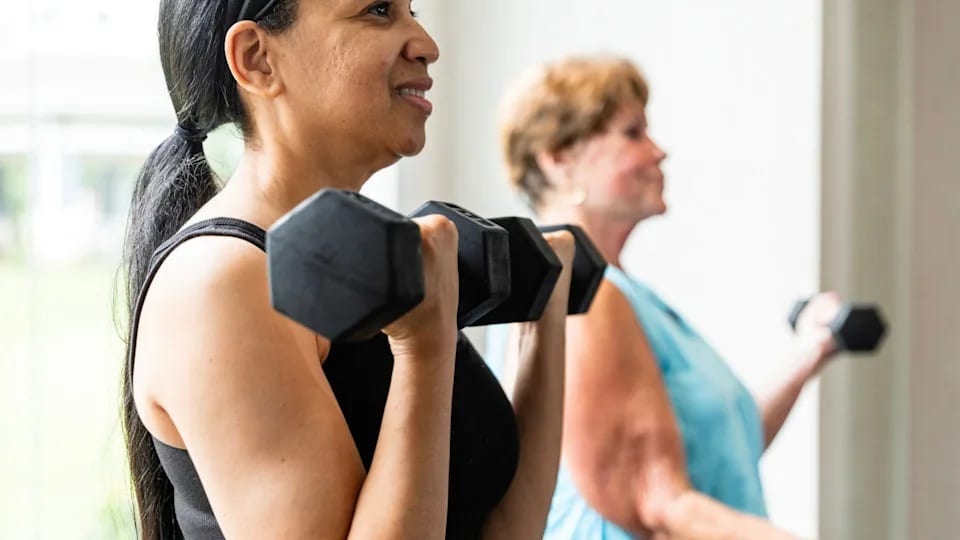
Here’s what happened when researchers actually tested that. In a landmark randomized trial called LIFTMOR, postmenopausal women with low bone density were split into two groups. One did light resistance work — under 60% of max, the “safe” prescription. Over eight months, that group lost bone density: their spine density fell 1.2 percent while they did everything they’d been told. So taking it easy isn’t an option. Not if you want to keep your bone density.
Option B: “Lift heavy, sprint, and whatever you do — no moderate cardio. It spikes cortisol and makes midlife women fat.” This is the message flooding your feed right now. And it’s half right. The heavy lifting part? Genuinely evidence-backed — we’ll get there. But the cortisol claims and the war on moderate cardio? I went looking for the trials. They don’t exist — independent reviews have traced those claims back to books and marketing copy, not to outcome studies in midlife women. Meanwhile, a meta-analysis of 101 randomized trials in postmenopausal women found aerobic training actually beats lifting for fat loss, and moderate-intensity work keeps delivering cardiovascular and metabolic benefits just fine.
So: one option under-doses you into decline. The other sells dogma wrapped around a grain of truth.
And look what that second message did to my friend. It didn’t push her to train harder. It made her dread training before she’d started. That’s the real cost of the hype — women pre-exhausted into skipping the window entirely.
There’s a third option — the one the trials actually tested.
What the research actually showed
The best studies in this population tested easy against heavy. Heavy won.
In the LIFTMOR study, the other group did two supervised 30-minute sessions per week: five sets of five reps at over 80–85% of max on deadlifts, squats, and overhead presses, plus a small dose of jumping and landing work. Eight months later:
Spine bone density: +2.9% (the “easy” group: −1.2%)
Hip (femoral neck): +0.3% (the “easy” group: −1.9%)
Adverse events across the whole study: one. A minor back spasm. In osteoporotic and osteopenic women lifting heavy twice a week.
Attendance: 92%. They kept showing up — because it worked and they could feel it.
A second trial (STOP-EM) ran the same style of program with women right in the transition — average age 53. Nine months, twice a week, same 5×5 at 80–85%, loads bumped 5% every time all sets were completed. Results:
Back squat: +30%
Deadlift: +22%
Leg power: +97 watts
Spine bone density: up versus controls
Exercise-related fractures: zero
Women in their fifties. Adding twenty to thirty percent to their lifts. While their bones got denser during the exact window they’re “supposed” to be losing 2% a year.
You won’t find numbers like that from an influencer promoting a supplement. These came from randomized controlled trials.
The system, in full
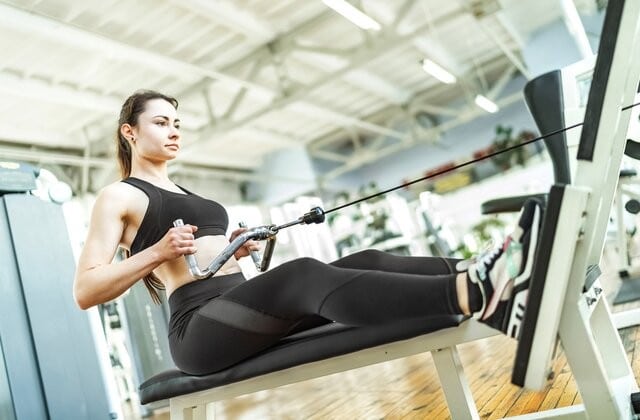
Four pillars. And understand this up front: nothing here is a special menopause program. It’s the same system I run with every athlete I coach — the trials simply prove how much more it matters right now. Take it and run.
1. HEAVY — twice a week, for your bones and your strength. Compound lifts that load the hips and spine: deadlift or trap-bar deadlift, squat, overhead press, rows. Work up to 5 sets of 5 at 80–85% of your max. Progress the load ~5% when you complete every set. Leave about 72 hours between heavy sessions. Thirty focused minutes. That’s the trial-proven dose.
A coaching note: think of 5×5 as the floor, not the ceiling. It’s what the trials proved. After 27 years I layer progressions on top of it — cluster work like five sets of five single reps, for example, pushes the intensity well beyond the base once it’s built. But the floor alone reversed bone loss.
2. FAST — because power leaves before muscle does. In a Finnish study comparing women of nearly identical age, vertical jump was already lower in perimenopause — before meaningful muscle was lost. Speed goes first. So we train it on purpose: jumps, throws, and moderate loads (40–70%) moved with fast intent, plus a progressive dose of landing work — the UK’s expert consensus statement on exercise for osteoporosis recommends building toward about fifty quality jumps and landings per session. A few minutes per session, done fresh, not as a sweat circuit.
3. CAPACITY — build the engine through intervals and recovery work. The menopause transition is a documented cardiovascular risk window — the American Heart Association’s (AHA) 2020 scientific statement says the cholesterol and body-fat changes are driven by menopause itself, not just age. So capacity work is non-negotiable. One interval day per week: in one randomized trial, sedentary postmenopausal women did 8-second bike sprints, each followed by 12 seconds of easy spinning, for twenty minutes straight — sixty short sprints — three times a week, and raised their VO2max 12% in eight weeks, with every woman completing the program.
And a note from my side of the gym: the engine doesn’t have to be built on a machine. The trials prove you can still adapt and improve capacity. How you build it depends on the result you want — and if the result you want is athleticism, then your capacity work should be athletic: speed, agility, quickness, movement. That’s how athletes condition. Then, on the off days: easy walking, cycling, mobility work as your recovery sessions. Recovery is training. Those are the sessions that let the hard ones land. Per the AHA, only about 7% of women in this life stage meet basic activity guidelines — 150 minutes a week of moderate activity plus two strength sessions. Hit the minimum first. Perfect it later.
4. FLEXIBLE — adjust sets first, then load. This isn’t a menopause invention either. Every client I’ve ever coached — men included — walks in some days carrying a bad week: rough sleep, a cold coming on, recovering from an event. So every session starts with questions. How did you feel after the last one? How are the joints? How’s the sleep? My clients know the routine. When the answers say it’s not the day, the adjustment is simple: cut sets first. If that’s not enough, reduce the load. The session still happens.
What makes this matter more during menopause is how often those days show up. A 2025 study of 187 female endurance athletes aged 40–60 — runners, cyclists, swimmers, and triathletes, women training 3+ hours a week — found what actually disrupts training: joint and muscle discomfort (affecting training for 97% of those who had it), broken sleep (92%), and exhaustion (87%). Not hot flashes — those were common but rarely the thing that wrecked a session. A week of adjustments isn’t failure. It’s smart training.
Two more rules that carry the whole thing:
If the scale is your main measuring tool, you’re measuring the wrong thing. Few things frustrate me more than watching women grade themselves by scale weight. The SWAN study — which followed thousands of women through the transition — found fat gain accelerates 2.3× with no change in the rate of scale-weight gain: body composition worsens while the number on the scale stays the same. The scale is one small input in a full evaluation. Body composition, strength, power, and how you move — that’s the scoreboard.
You don’t start heavy. You build up to heavy. Every athlete returning to training gets a preparation period: one to three months of technique and tissue work before the loads get heavy. Every successful trial ran the same phase. If a program takes you to heavy barbells in week one, walk away.
What waiting costs
The menopause transition lasts four to eight years whether you train or not.
Bone loss through the transition runs about 2% per year for roughly three years, starting about a year before the final period — around 10% across the decade — and the spine loses density faster than any other site. Bone lost in that window predicts fractures decades later, and it is slow and hard to rebuild afterward.
You’re going through it either way. The only variable is what you’re holding when you come out the other side.
And if you’re reading this at fifty-eight thinking you missed the window — the LIFTMOR women averaged sixty-five, and they still built bone density. The window is the best time. It is not the only time.
What this won’t do (read this part)
I’ll be straight with you. You deserve the full picture before you start — and this is the part most programs leave out.
It won’t cure hot flashes. The Cochrane review calls the evidence on exercise and hot flashes insufficient. What training reliably improves in the trials: strength, power, bone density, insomnia severity, mood, and cardiovascular fitness. That’s the honest list — and it’s a good list.
It’s not instant. The slow part is muscle size. One well-designed trial trained early-postmenopausal women identically and found the group without estrogen got roughly half the muscle growth (+3.9% vs +7.9% quad size). Half is not zero. They still adapted, meaningfully. Strength and bone density are a different story — you watched them climb in the trials above, in months, not years. The results just demand consistency and patience.
Your starting point matters. If you have low bone density, existing fractures, pelvic floor symptoms, or you haven’t trained in years, the entry point changes — a check-in with your doctor (bone density, blood pressure, anything unresolved), a proper assessment from your coach, and a longer build-up. And one movement rule: don’t round your back under a heavy load. To be clear, deadlifts are not the problem — the trials used them safely.
And your doctor stays in the picture. Hormone therapy is a decision between you and your physician. Everything here works alongside whatever you two decide — in the trials, women adapted with hormones and without them.
Where a coach comes in
Everything above is free, and if you take it and run it on your own — honestly, good. Do it. It works.
What I actually do for clients is the part an article can’t: make sure the loading is right for your body, run the build-up phase so heavy is safe, adjust the plan through the bad-sleep weeks and the cranky-joint weeks so they don’t turn into lost months, and track the numbers that tell the truth — strength, power, body composition, how you move.
You’re an athlete. Menopause doesn’t change that. It just changes the game plan.
And my friend from the top of this article? Her next text offered to be my guinea pig — before she’d seen a single session. That’s how ready women are for someone to take this seriously.
A note on the evidence: every claim above links to its source — randomized trials and long-term cohort studies, not marketing. Where the science is settled, I said so; where it’s unsettled (hot flashes) or slower than we’d like (muscle growth), I said that too. That’s the standard I hold this content to: if a claim can’t be backed by research, it doesn’t make the article.
If you want it built for you, it starts here: scorecard.athleteforlife.ca.
Stay athletic,
Jeremy
–30–
Jeremy Hudson is a strength and conditioning coach (NSCA-CSCS) with 27 years in the field. He runs Athlete for Life in London, training adults in their 30s through 60s to move like athletes again. Curious how you’re actually holding up? Find your Athletic Age in three minutes: athleteforlife.ca