
Who Says You Can’t Come Back?
20 Years Later, A Look Back At Pitching For The London Majors
by Jeffrey Reed, Editor, LondonOntarioSports.com
Yesterday marked the 20th anniversary of my appearance on the mound for the Intercounty Baseball League London Majors. It’s funny how it seems like that inning pitched at Bernie Arbour Memorial Stadium in Hamilton took place 40 years ago, not just two decades earlier. Yet, as I reminisce about my two improbable seasons in 2000 and 2001 with the Majors ballclub, some things seem like they happened only yesterday.
If you’re not familiar with my story of playing sports as a disabled athlete, then you can read about it here. I look forward to a post-COVID-19 pandemic life which will again allow me to speak to groups of all sizes about following your dreams and never giving up hope, no matter what the odds. And when you look back at my two seasons in the sun with the Majors, then you’ll realize that a real miracle had occurred.
In fact, pitching – and coaching 3B – with the semi-pro Majors ballclub did not represent my first baseball comeback. At age 15 and playing my senior year of bantam baseball with the Eager Beaver Baseball Association Mornington Park Padres, I suffered a major injury when I tore my right trapezius muscle. There was much buzz about my playing abilities as a 13-, 14- and 15-year-old pitcher tagged as a five-tool player. Eying U.S. college ball and with a handful of enquires from U.S. colleges, that injury put me on the shelf for a season and a half and ended my college ball hopes. Years later, it was discovered that undiagnosed skeletal deformities led to that injury.
In 1979, the year that my beloved Pittsburgh Pirates won their last World Series, I re-entered baseball as a 17-year-old pitcher and catcher with a new all-star squad, the Huron East All-Stars, playing out of Mornington Park – just 90 feet away from the home of late, great Majors coaching legend Norm Aldridge. This would prove to be significant as I joined the Majors in 2000.

The author ready to hit infield with the London Majors at Labatt Park 2000.
Years had passed, beer league baseball had been put on the shelf for a career in journalism, and playing baseball, I had thought, was all but a distant memory. But the London Majors had always been a big part of my life, both personally and professionally. It’s safe to say, no one has played more roles with the Majors and the IBL than yours truly. Consider that from age 7 to 40, over a 33-year span, I filled the following roles: scoreboard operator (Majors legend Arden Eddie, who would later be my teammate, paid me 25 cents, a hot dog and Coke for operating the old wooden scoreboard in right field); foul ball chaser; occasional bat boy; team photographer, media relations director, radio and TV colour and play-by-play; founder of the IBL media relations office in 1994, the year wood bats returned to the loop; print, broadcast and new media reporter; and RHP from the pen plus third base coach for two seasons.
Comeback
In 1999, I decided that I wanted to pitch for the Majors. I was 37 and out of shape, but I knew in my heart that when at my best, I would not embarrass myself playing in the IBL. In fact, I knew that with my sidearm delivery and sinker that I could get IBL hitters out. But in ’99, I had not fully committed to the comeback.
During a tryout at Labatt Park, I was throwing darts from the outfield and finding the strike zone from the mound, if only with an 85-mph fastball. But my endurance died quickly, and I embarrassed myself in the cage where I was met by Aldridge as I dragged my tail into the Majors first base dugout.
“You’re not nearly ready for this, big guy,” said Aldridge, his hand on my shoulder and keeping it real, as he always did. I remember now as if it was yesterday, looking at Aldridge and saying, you’re right. I need to put the work in, and then I’ll be back next year.
That 1999 summer, fall and winter, and into spring 2000 I put myself through hell. Living with club feet, an underdeveloped left leg, protruding pelvis, scoliosis, spina bifida occulta and a deformed jaw, at first I could not run the length of the soccer field in my neighbourhood park before doubling over in pain. As I tried to regain my form as a pitcher, I am sure my fastball only clocked in the low-80s as I threw to a small stenciled square on the side of a local public school.
I’m a big believer in mentors, and I had found one in my brother, Greg, who was a lead trainer with GoodLife Fitness. My little brother – who played both football and rugby for the Sir Wilfrid Laurier Golden Hawks – put me on a strength and cardio program which changed my life. Aware of my disabilities, Greg was smart about the program he had assembled. And when 2000 tryouts arrived, I was ready for another shot at suiting up with the Majors.
With team owner Arden Eddie having stepped away from the ballclub, Ron LeClair now took over as manager. I was a much different athlete in 2000 than I was in 1999 – I had lost 20 pounds and was in much greater shape than when Aldridge hat set me straight at the batting cage. And although I still had a long way to go in order to truly reach my peak conditioning, I knew that I would, in some way, be a valuable member of the ballclub.

The author flashing signs from third base box at Labatt Park 2001
I didn’t sign as a player that year, but I was handed a new lease on my baseball life when the club named me its third base coach. Was this really happening? Do I get to run out of the Roy McKay clubhouse with my spikes, up the ramp and onto the historic Labatt Park diamond, where my baseball heroes including Eddie, Mike Kilkenny and Wayne Fenlon had played? Even though I did not sign a player’s contract, I was now a London Major.
The Guelph Royals swept us in the first round of the playoffs that year, but it was one of the most memorable summers of my life. I can’t say enough good things about my teammate, all-star third baseball Dan Mendham, a clubhouse leader who also led by example on the field. He fully accepted this ancient scribe – by baseball years, anyways – who had left the press box to play Walter Mitty, and, for the most part, most of my teammates accepted me, too. “Timber,” as we called Mendham, respected my baseball knowledge and my work ethic, and I thank him for that.
But there were exceptions. One veteran bench player, who had refused to watch for – or even learn – the signs from the third base coach’s box threatened to rearrange my body with martial arts, simply because I had asked him to come to a game early in order to go over the signs. “You can’t talk to me like that. I’m a veteran on this club. Disrespect me like that again I will mess you up. Let’s go right now!” When I refused to engage in fisticuffs, he laughed and called me names that ballplayers usually save for the opposing team after a knockdown pitch. The next year, he had signed with another team. No one missed him on the field nor in the clubhouse, where I am told a similar incident had taken place before I had joined the club.
In fact, my teammates who gave me the hardest time during my two years with the Majors were players who had recently been let go by Major League Baseball minor-league squads. I got it: they had not yet accepted the fact that their pro baseball dreams had died, and they were bitter. And who was this soon-to-be 40-year-old newcomer – a reporter, of all people – doing in uniform with the Majors? I recall one player who had been let go by the Yankees, mocking me at Christie Pits in Toronto when I was playing long toss with fellow pitcher Ryan Reid. “Relax, Reed,” he said to me and within earshot of the entire team, “there are no scouts here today.”
Pitching For London Majors
With a year of Majors baseball under my belt, I had an up-close-and-personal look at IBL baseball between the white lines. That off-season, 2000-01, I put myself through boot camp, never missed a day in the gym, worked my ass off to get in the best shape possible, and set a goal of pitching for the Majors while still coaching third base.
But all was in jeopardy when Eddie had announced he would return to the ballclub as manager – bringing along with him the team bus which had logged way too many miles along highways 401 and 403, and another year for him to play IBL baseball. In 2000, we didn’t have a team bus, so we car pooled. Eddie still owes me gas money – I can laugh about it now, obviously. Imagine driving the equipment, the bat boy, utility player Chris Chant and first baseman Simon Galarraga to Hamilton during a torrential downpour, with no game cancellation yet, and then getting a flat tire near Ingersoll? Chant, whose nickname is, Buff – we called him, Animal – is now an orthopaedic surgeon. He skillfully and single-handedly changed that tire while Galarraga sat in the car, complaining about not being able to hit the curve ball. True story. When we arrived at Bernie Arbour Stadium, late team owner Brian Hanson declared the game was rained out. Thanks for the heads up, Brian. He was a beauty! When I operated the league media relations office, I would have to track him down at a local watering hole before getting the stats and highlights for my evening report. But Hanson and I got along very well, and I miss him.
Back to Eddie’s return in April 2001. I remember our first practice, at the LDBA diamond in north London. In terrific shape, I led the team in sprints around the diamond, only to hear a former Blue Jays minor leaguer, Steve Charles, bellow, “Somebody’s been running indoors!” Playing catch with new catcher Scott Smith, I was throwing very well – my old arm had returned, which prompted Eddie to say to no one in particular, “Jesus, JR is throwing hard!” I loved the nickname, given to me by Mendham the year previous. It was an easy one – my initials. Could have been worse: the Ancient Major, perhaps, or, Dad, or Gramps.

The author, working on a chew prior to London Majors opening day 2001
Throwing to “Smitty” in a simulated game, Charles promptly hit a double off the centre field fence. “I felt bad about that,” said Charles. So did my catcher – and this is also significant in my comeback. I recall saying to Smitty while warming up for that game, I have nothing today, so it will be smoke and mirrors. My catcher agreed, and I didn’t blame him.
So, I remained the third base coach – and, I impressed Eddie enough for him to sign me to a player’s contract. When Eddie told me this, emotions got the best of me, and I had to bury my face, tears streaming down my cheeks, into my glove and in my locker. Note: I had always worn No. 17, but that number was retired. Tommy White, pitching legend with the 1948 World Sandlot champs, and Kilkenny had both worn No. 17. I wore No. 10, but for good luck, I lockered under White’s jersey hanging on the wall above me.
It’s important to note that my desire to pitch never once interfered with my coaching duties. In fact, I enjoyed coaching even more than pitching. My routine would see me arrive at Labatt Park between 1 p.m. and 2 p.m. for an evening ballgame. I would do my own stretching and running, throw BP in the cage beneath the left field grandstand or hit fungos to early arrivers, grab an early dinner in the clubhouse and enjoy some banter with my teammates, then throw BP, hit fungos and prepare for the game. Whenever I could, I played long toss and threw from the mound.
There’s a funny story from 2000 on a day when my arm felt particularly good, and I was playing long toss with pitcher Kevin Thomas. Current Majors co-owner, GM and manager Roop Chanderdat, a teammate during that summer, stood beside me along the first base line while I threw some absolute ropes to Thomas in deep centre field. You could feel Chanderdat – a marginal player at best – deflate from head to toe as he watched this older rookie out throw him by a country mile. I almost felt bad for Chanderdat – almost.

Roop Chanderdat and Jeffrey Reed at Labatt Park 2016
But the truth is, despite what was said at Christie Pits, I only wanted to lead by example. If I could run, throw and, by that season, impress in the cage during BP to an elite level, then the youngsters on this squad should find inspiration in those efforts, not jealousy. But a baseball clubhouse is not immune to feelings like those felt on the outside, and so there were teammates who thought I was hot dogging or showing off. I always hustled, even when I ran to and from the third base box. And if anyone had realized what it had taken for me to be with the ballclub, then hopefully, I said to myself, they would realize that I am only giving 100 per cent for the team.
My arm, for the most part that summer, was in great shape, tossing in the high-80s and at time low-90s, when I found another gear, and without a doubt I was a valuable member of that pitching staff. I warmed up a dozen times in the bullpen, but for whatever reason – and I have my opinion – Eddie did not put me into a game until the very last regular season contest at Hamilton on July 23, 2001. There were probably 10 teammates that summer who told me to approach Eddie about pitching, because, in their words, the team could use me. But I didn’t ask Eddie once. I kept my mouth shut, and worked my ass off as third base coach to help our team win. Unfortunately, Guelph again swept us in the first playoff round.
There was one game, though, when I should have gotten the call from the bullpen but again was ignored by Eddie. As we left the field, the men’s over-30 league started to warm up at Labatt Park. I looked out at the field and said to Charles, maybe I should go play with them. Charles stopped in his tracks, grabbed me the shoulders and said, “JR, you’re better than that.”

The author, hitting infield at Labatt Park 2000
Even though I was in great shape that summer, baseball did not come without a price. Admittedly, I took way too much ibuprofen for the constant pain. Hot baths after every game were my best friends. But living with numerous disabilities, I was constantly in pain. I recall not even being able to undo the laces on my cleats after a game, and asking pitcher Derek Bloomfield, who lockered beside me, to help me out. He did. We also shared a love of country music. I am sure, though, that not one person on that club knew about my disabilities – and I never told anyone. If I had, then there is no way Eddie would have let me pitch, let alone coach.
Pitching At Bernie Arbour
On the final day of the 2001 regular season, Reid hurt his arm pitching in the 7th inning, and the bullpen was exhausted – minus a 39-year-old coach who had not pitched at all that season, although he had shown some great stuff in practice and in the bullpen. But at season’s end, my old body, riddled with disabilities, was done. I was worn out and using smoke and mirrors just to get by coaching that night. But with Reid out, he, Eddie, Smitty and I huddled near the dugout. Finally, Smitty raised his voice at Eddie and said, “Arden, stop waiting, get JR warming up. We need him!”
What surprised me was that, even then, Eddie hesitated putting me in the game. He was always a complicated man with a big chip on his shoulder, yet here he was, waiting until Smitty demanded I warm up before he put me in the game.
As luck would have it, my arm was dead that night, just like the rest of my body. But as I ran to the bullpen to warm up, I surge of energy took over and I was able to clear the mechanism: I saw nothing but Smitty’s glove and heard nothing but his voice.
The lighting was poor and the mound was terrible (and low) at Bernie Arbour Stadium, but I felt like I was pitching at Yankee Stadium. I had two pitches that night: a mediocre fastball, and a sinker which, because of my neck injury, took an ungodly sharp dip in on a right-handed hitter’s shins. LeClair once told me that some of the boys refused to take BP with me on the mound. Sorry, boys.
Being a pitcher at heart, I purposely hit a batter with one out. Smitty had told me at the mound that the Cardinals were yapping about taking me yard. I promptly plunked the next batter in the ribs when he crowded the plate – not sure where that fastball came from, but I am glad it did. With runners on second and third and two out, I faced the current IBL lifetime leader in home runs, hits and RBIs, Sean Reilly, then a promising young pitcher and infielder. With a 3-2 count, I threw an off-speed back door slider and watched Reilly stand at the plate like a pedestrian.

Cheesing it up before my first Majors game, with my trusty fungo bat
Here I was, a 39-year-old disabled athlete – an IBL rookie – retiring the side with a strikeout on a night when London’s best midget ballplayers were throwing harder than me. My line: 1 IP, 1 hit, 1 HB, 1 K. I said to Eddie as I ran off the field, “Thanks, Arden.” He replied, “The game’s not over yet!” Brain freeze. I threw on my jacket and ran down to the third base coach’s box in the top of the 9th inning.
We lost that game – afterwards, a handful of Cardinals players clapped for me and said, “Good job, coach.” Eddie presented me with the game ball, and said he was sorry I didn’t get an at bat. Many of my teammates came over to me in the locker room and shook my hand afterwards. I was overjoyed that my wife, Beth, my sister, Becky, my nephew, David, and my niece, Melissa, were all in the stands watching me pitch.
Things were never the same after that season. Chanderdat and Scott Dart would eventually purchase the ballclub, and despite being close have not yet captured an IBL championship which has eluded the team since 1975. I knew that I had achieved my goal of pitching in the IBL, and so I put playing baseball on the shelf for good. I’m sure part of the reason I made my comeback at age 39 was because of some sort of midlife crisis. But as someone who lives by the creed, Carpe Diem, and as someone whose baseball skills were good enough to play in the IBL, I knew I had to work hard, dream big and play with the Majors.

I can’t end this piece without thanking my catcher, Smitty, who I have recently reconnected with on social media. Today, he owns and operates Smith Funeral Home in Sarnia. I’m not sure if my fastball, which was dead on arrival at home plate in Hamilton, had anything to do with his career choice. All kidding aside, Smitty was a calm voice for me as my heart raced on the mound at Bernie Arbour Stadium, and he was a great teammate. Thanks for all you did, Smitty – and for not laughing at my fastball!
Return To Bernie Arbour
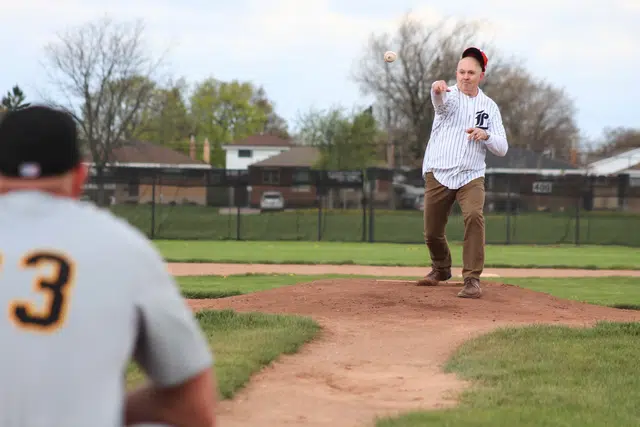
The author throws out the first pitch at Bernie Arbour Memorial Stadium, July 23, 2001
May 8, 2016 was one of the most emotional days of my life. It marked my first return trip to Bernie Arbour Stadium since that night in July 2001. Cardinals GM Krystle Thompson invited me to throw out the first pitch on opening day versus the Kitchener Panthers. It was Panthers first baseman Sean Reilly – who I had struck out to end my career on July 23, 2001 – who caught the ceremonial first pitch. I won’t blame my emotions for bouncing my pitch to the plate from the mound, but as I was introduced from the press box, tears filled my eyes. It was a great day, but a little odd as I wore a Cardinals hat and my Majors jersey while visiting the boys in the locker room before the game. Just like my Majors teammates, I am sure few understood the significance of my appearance.


The Courage Award
That year, Beth and I decided to use our platform, LondonOntarioSports.com, and my improbable two years with the London Majors in order to recognize the amazing stories of other Southwestern Ontario athletes who have also followed their dreams. Since 2016, the Jeffrey Reed Courage Award has awarded six athletes with $6,000, a commemorative plaque and an awards banquet for achieving greatness on and off the field.

Jeffrey Reed with Courage Award winner Allie Vlasman of the Fanshawe Falcons
My hope is that today’s London Majors and future Majors apply for and eventually win the annual Jeffrey Reed Courage Award. That would certainly see what I was able to accomplish come full circle. You can read about the Courage Award here, and read the biographies of past winners here. Nominations for the 2022 Jeffrey Reed Courage Open open Labour Day weekend – watch for details.
No IBL experience, years away from the game and numerous disabilities did not stop me from working hard in order to live my dream of pitching for the London Majors. Doctors told my parents that I would never run and never walk in a normal manner. Yet with the help of mentors and a bulldoggish attitude, I achieved the impossible.
Twenty years have passed, and yet I still get chills thinking of pitching at Bernie Arbour Stadium. With age 60 around the corner, there is no comeback planned – at least, not as a player. Who knows what the future holds, though? I’m just glad I was able to live my dream, and now, more importantly, use my story to inspire others and to recognize them with the annual Courage Award.
-30
Jeffrey Reed has been a member of the London sports media since 1980. A three-time author and winner of multiple writing awards, Reed is publisher and editor of LondonOntarioSports.com, London’s leading sports publication. Reach him at jeff@londonontariosports.com.