CB Radio: A Fresh Look At A Hobby Classic
CB SSB: Revisiting A Classic Mode Of Communications
A self-confessed radio junkie finds his latest fix in a vintage rig
by Jeffrey Reed, Popular Communications August 2010

As a radio aficionados, there are few things we love as much as filling our shacks with the latest high-tech toys. Even if budgets are too tight, it’s just as much fun to research for hidden treasures, not unlike Indiana Jones on a quest for precious artifacts. It’s all part of the hobby of radio communications.
My latest treasure hunt yielded quite a bonanza: a Cobra 135 SSB (Single Side Band) base station CB radio in terrific working order. Discovering the Cobra 135 online truly qualified as finding a needle in a haystack. Imagine my delight when a local seller was glad to unload this classic CB right onto my lap. Better yet, my initial on-air contact with the local SSB operator who offered resounding approval of my strong, clear signal made for one happy radio junkie.
Sure, my shack already included a Cobra 148GTL 40-channel mobile CB used as a base unit, but the addition of a Cobra 135 added a gem to my shack and also provided a trip down memory lane.
SSB: A Brief History
Single Side Band (SSB) CB is an entirely different animal compared to simple AM mode operation, yet they are communications cousins. They share the same 11-meter radio spectrum and channels, but that’s where the similarities end. SSB CB can provide twice as much range as AM under identical conditions, and can provide up to 12 watts legal peak power versus 4 watts for AM. Voice quality is crystal clear compared to sometimes static-filled AM. The secret lies in additional circuitry which we’ll talk a bit more about later in this article.
Before SSB became available, the FCC issued the first licence for CB radio, or Class “D” 27 MHz band in early 1948 to Al Gross. He communicated with licence 19W0001 of the Citizens Radio Service. By the 1960s, truckers, small business operators and radio hobbyists were using CB transceivers on a daily basis. Then it hit with hurricane force.
When the U.S. government imposed a 55-mph speed limit during the Arab oil embargo of 1973, and concurrently with a gas shortage, much media coverage was given to truck drivers who were communicating via CB radios to locate gas and to warn others of police speed traps. The CB craze was born.
Add C.W. McCall’s 1976 song, Convoy, and a movie by the same title in 1978, and you had a communications phenomenon that would not be surpassed until the Internet was born. CB was so popular, you could walk to the corner store, purchase a mobile CB transceiver and antenna for as little as $75 and, after a quick installation, join in on the fun – if you could get a word in edgewise. With the original 23 channels clogged, the FCC allowed 40 channels in 1977 and that’s where things remain today.

Cobra 135 SSB base CB
Higher-end CBs boast both AM and SSB, effectively providing 120 channels. Under normal atmospheric conditions and using properly installed antennas, two home – or base – SSB CB operators can communicate over a distance of up to 40 miles.
SSB CB equipment has been available since 1964. In Tom Kneitel’s book, Tomcat’s Big CB Handbook, the founding editor of Popular Communications wrote: “The first commercially-produced CB side band rig was a result of a project in early 1963. Mark Products, a division of Dynascan, hired Gil Kowols to design a CB side band transceiver.”
Kneitel, who passed away in August 2008, also wrote: “Manufacturers such as Tram, Browning, Stoner, CPI, Cobra and others produced side band transceivers that live on in both legend and also in actual current use.”
I was delighted to find Kneitel’s description of my shack’s latest addition, the Cobra 135. He wrote: “The Cobra 135 was a dazzling base station that had a mystique of its own and still has a cult of fanatic followers.”
In 1967, E.F. Johnson Company released the SSB CB radio and helped fuel SSB popularity, but it wasn’t until the 1970s when combined AM-SSB radios hit the market that SSB soared to enormous heights.
How Does It Work?
The secret behind SSB really is no secret. It’s just a more sophisticated design. With AM transmissions, the power is distributed across the carrier in upper and lower side bands. SSB is much more efficient, however, using only one of the side bands to get your message across. Because there is no carrier, unless you speak into a keyed microphone, the operator at the other end will hear nothing and see no signal on his S-meter.
SSB also boasts less noise and interference than AM. Forget about heterodyne whistles when two or more AM CB operators transmit at the same time. However, if you’re conversing via SSB (channels 31 through 40 are typically preferred for SSB, with different communities using their favourite channels), you will occasionally hear heterodyne interference from AM operators in the same channel. AM operators may also hear interference from SSB operators which can sound a little like Donald Duck yapping in the background. Either way, common sense applies. Find another channel yourself, or politely ask those interfering to find another channel.
SSB Language
The culture of SSB CB operators is itself a distant cousin of the AM CB hobby. If you shout out on SSB asking for a radio check or looking for a good buddy, you’re bound to be scorned by veteran SSB operators. SSB is a place where normal, everyday conversations are welcome. It’s sort of like ham radio without the required licence and tech knowledge. SSB conversations are not rushed shoutouts looking for the nearest gas station, a time check or confirmation that your rig sounds crystal clear. Rather, SSB promotes friendly conversation, not unlike amateur radio in a very relaxed setting.

Cobra 148 GTL mobile CB
The SSB CB universe has seen clubs like the SSB Network (established in 1964 and at one time the world’s largest such organization with more than 125,000 members) unite SSB users under one moniker. The lingo takes on a more everyday flavour, but may incorporate Q-signals rather than the 10-code. For example, QSY translates to “switching to another channel,” and QSL means “transmission acknowledged.”
SSB Today
Despite its current comeback, CB radio remains just a shadow of its 1970s self. There remains, however, a loyal group of SSB operators, as I found out when I put the Cobra 148GTL and then the Cobra 135 in my shack. Within minutes, I was able to find local SSB users and carry on a normal conversation – a pleasant change from the constant chatter on channel 19 in the AM mode. Don’t get me wrong, listening to the professional drivers on 27.185 MHz is a constant companion for me at my home office. But when it’s time to grab a cup of java and chit chat with some local CB operators, the time spent on SSB is much more leisurely and relaxed, not to mention crystal clear.
Rigs Of Dreams

Writer Jeffrey Reed conversing via SSB, August 2010
Permit me to revel a bit more in serendipity of the Cobra 135 in my shack. As a teenager in the mid-1970s, I only dreamed of owning this rig, so it’s surreal to see this beauty sitting on my desk today. The woodgrain case combined with gleaming black finish and silver knobs, not to mention large SWR meter and old-style flip clock, makes for a great conversation piece. The casing is a little rough around the edges, but again, it’s in fantastic working order, which is what really counts.
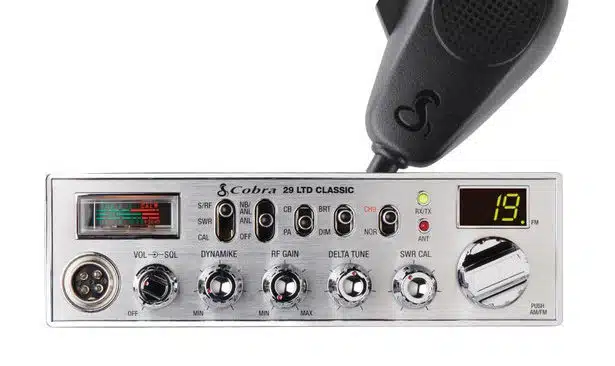
During its heyday in the early- to mid-1970s, the Cobra 135 cost about $450 US. It served as the inspiration for later rigs, including Cobra’s 2000GTL base station and the 2010GTL WX. Cobra’s 148GTL is a full-featured SSB mobile radio picking up where the famous Cobra 29LTD leaves off with its AM-only operation.
Galaxy also manufactures some very nice SSB radios, including the DX 2547 base unit and DX 959 and DX 979 mobile rigs. Another nice radio on today’s market is the midland 79-290 mobile unit with WX NOAA weather reception. Again, expect to pay slightly more for SSB units than you would pay for AM-only CB radios.
History Repeating?
Still not convinced that CB radio is on the comeback trail? It only makes sense that in today’s communications crazy society and struggling economy that an inexpensive communication method would be welcomed with open arms. Road Trip America, a premier online destination for North American road trip information, has stated about CB radio: “These relatively low-tech devices are enjoying a resurgence of popularity among professional truck drivers and road trip enthusiasts for some very good reasons. They’re relatively inexpensive to buy and free to use. They work well and they provide communication under circumstances where other forms of technology still don’t do a very reliable job.”
I can’t argue. And in the case of SSB, it adds just another element to my ever-growing hobby of communications.