Ready To Roll With CB Radio
Soaring Gas Prices Making Road Travel Painful? Turn On An Old Friend. Communications On 11 Meters Is Still A Great Way To Go!
by Jeffrey Reed, Popular Communications July 2008
Anyone who believes Citizens Band Radio has gone the way of the Dodo bird should think again. In fact, CB (11 meter 26.965-27.405 MHz) communications is alive and well and most likely living in your neighbourhood.
With apologies to Burt Reynolds, don’t go organizing a convoy to avoid Smokey Bear anytime soon. Unlike the 1970s CB craze which fueled movies like Smokey and the Bandit, and hundreds of CB-themed songs – which in turn saw the CB phenomenon positively explode – today’s CB culture breeds a more mature mode of communicating.

Sure there will always be those who disregard on-air etiquette, not to mention rules and regulations of the FCC (and north of the border, Industry Canada, formally the Department of Communication or DOC). But perhaps a spinoff of today’s wired 24/7 society, CB radio is making a comeback among the general population.
And this summer, in particular, with its soaring gas prices reminiscent of the 1970s, there’s sure to be a lot of CB chatter as truckers and other drivers communicate with each other looking for cheaper gas. It’s déjà vu all over again.
Truckers, these days referred to as professional drivers, are still by far the largest population to embrace CB radio, and long-distance haulers are sophisticated professionals, indeed, with truck cabs housing everything from laptops, satellite GPS, and yes, the old-reliable CB transceivers. But average Joes like you and me also find CB radio to be inexpensive – although at times limiting – method for quickly obtaining information like bad weather and traffic warnings, as well as travel directions. And it’s still a great way for business operators and family members to keep in touch within city borders.
CB: A Brief History
The FCC issued the first license for CB radio – or Class “D” 27 MHz band – in early 1948 to Al Gross. He communicated with license 19W0001 of the Citizens Radio Service. By the 1960s, truckers, small business operators and radio hobbyists were using CB transceivers on a daily basis.
Then, it hit just, like a winter snowstorm. When the U.S. government imposed a 55 MPH speed limit following the oil crisis of 1973 and the concurrent gas shortages, much media coverage was given to truck drivers who, in fact, were communicating via CB radios. Thus, the CB craze was born. Drivers communicated to locate gas and to warn others of speed traps.
Add to the mix C.W. McCall’s 1976 song, Convoy, which spurred a movie by that same title in 1978 and you had a communications phenomenon that would not be surpassed until the Internet was born. CB was so popular, you could walk to the corner store, purchase a mobile CB transceiver and antenna for as little as $75 and, after a quick installation, join in on the fun – if you could get a word in edgewise.

With the original 23 channels clogged the FCC allowed 40 channels in 1977, and that’s where it remains today. Higher-end CBs boast both AM and SSB – upper and lower single sideband models offering 12 watts of power – and thus provide 120 separate channels. Under normal atmospheric conditions and using properly-installed antennas and lawful 4-watt AM transceivers, two home (or base) CB operators can talk over a distance of about 20 to 40 mile (mobile-to-mobile and base-to-mobile distances are less, and walkie-talkie communications lesser still).
Yet despite the fact communicating via CB radio is obviously limited compared to conversing via the Internet or cell phones, it is a cheaper mode of communicating and it does serve a purpose. For a 10-year span from the mid-1970s to the mid-1980s, talking to your neighbour or your friend across town via CB was as common as emailing your loved ones across the country is today. But before you could say “BlackBerry,” the CB band of almost 30 years ago had become out of control – so much so that both the FCC, and later the DOC, delicensed what it labelled the General Radio Service (GRS) band.
CB Remains Important, Continues To Grow
It’s nearly impossible to estimate how many CB radios are now in use across the United States and Canada, let alone the rest of the world – including in the UK where CB use is reportedly on the rise. Today, we have FRS, GMRS, MURS and 900 MHz FHSS alternatives, not to mention 10 metre radios and all other radios used by ham radio operators. But nowhere else is there such a unique and useful mode of communicating as CB radio.
Case in point: This past winter, a vicious winter storm caused havoc along Highway 401 southwest of Toronto, Ontario. A 75-vehicle pileup during a whiteout stemming from Lake Huron caused panic on one of the busiest stretches of highway in North America. What was the first point of contact for motorists heading in that direction? CB radio.
“Quite honestly, I am a ham radio operator, but if a storm comes along, I turn on the CB and slip down to channel 19. I want to hear what the truckers are saying. They don’t steer you wrong,” says Ralph Gray of Durham Radio, a Toronto-area radio superstore that counts professional drivers as its biggest CB clientele.

Cobra 29 LTD BT with Bluetooth wireless technology
Gray says that, like everything else, CB radio popularity follows a cycle. “People are getting back into CB, although not like the 1970s, but just when you think it’s dying off, out come some new products.”
The latest CB product comes from arguably the leader in CB radio manufacturing: Cobra Electronics. In February, Cobra released the 29LTD BT, the first-ever CB radio with Bluetooth wireless technology. Telephone calls are synched with the CB radio. A noise cancelling microphone allows calls to be heard loud and clear, even over a noisy engine. Incoming audio is routed through the radio speaker and you can answer and terminate calls with the push of a button on the mic, and use auto redial, allowing you to stay focused on the road.
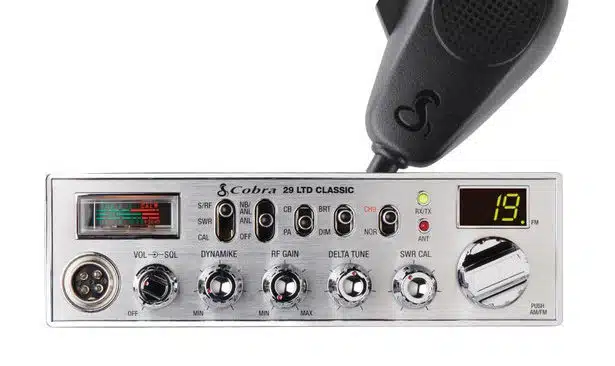
Gray calls Cobra the “industry leader.” In fact, the Cobra 29 LTD Classic and its big brother, the Cobra 148GTL with SSB, are mobile radios that remain two of the most popular CB radios of all time.
Ramon Sandoval, Cobra’s CB radio product manager, says the 29 LTD Classic is Cobra’s “most popular, best-selling model. It’s the number one choice of the professional driver, who is the biggest user of CB radio today.”
According to Sandoval, “Modern technology will allow you to communicate with people all over the world, but CB radio is mainstream America. CB is alive and well.”
Ray Anderson, a technician with San Diego, California-based Galaxy Amateur and CB Radios, agrees with Sandoval that the Midwestern U.S. and parts of the Southern U.S. are the most popular areas for CB use. And, Anderson agrees CB communications has cornered a niche market.
“We thought CB would die off, but it hasn’t. For truck drivers, it’s a tool of the trade. For you and me, it’s a hobby. It’s like having a cell phone, but everybody knows what channel to be on, so it is unique. All you need is a cigarette lighter plug, a magnet mount antenna and you have instant communications.”

Galaxy DX2547 base CB
Galaxy makes one of the few CB base units on todays’ market: the Galaxy DX2547, a full-featured AM-SSB radio with large frequency display. The company’s best seller is the DX959, a full featured AM-SSB mobile radio with five-digit frequency display. Galaxy’s newest radio, the DX939, is an AM mobile radio boasting night view with a starlight faceplate and glow-in-the-dark green and blue lettering.
How To Join In On CB Chat
Joining in on CB communications is a relatively simple operation. While no license is required, you still must abide by the rules of the FCC, and Canadians by the rules of Industry Canada. Purchasing a CB today is just as easy as it was in the CB heyday of the 1970s, thanks to the Internet. And if you don’t have Web access, well, it’s unlikely that your neighbourhood 7-11 sells CB radios along with Slurpees, there are radio superstores and other brick and mortar retailers, too. Another common carrier of CBs, antennas and accessories is the travel centre. Think of it as a truck stop on steroids. Centres like Flying J Travel Plazas carry a number of CB models and accessories, not to mention a variety of vehicle and travel necessities.
Handheld CBs
The simplest way to jump right in is to purchase a walkie-talkie – or handheld – CB unit. One of my first CB radios was a Radio Shack TRC-180, 2-Watt, 3-channel walkie-talkie that required transmit and receive crystals. I’ll never forget making contact for the first time with a truck driver in the early 1970s. I have been hooked on CB ever since.
Later, I used 40-channel walkie-talkies including the massive but pretty TRC-209, and the more modern, slim-lined TRC-216. It’s tough to find low-powered walkie-talkies today, now that kids prefer transceivers like FRS radios, or better yet, cell phones. However, there are still a number of full-power, 4-Watt 40-channel CB walkie-talkies on the market, including Midland Radio Corporation’s duo with BNC antenna connectors. The 75-785 with LED channel display, and the 75-822 with built-in 10-channel NOAA weather plus dual function as a mobile unit. Today, top handheld units cost between $50 and $150.

Galaxy DX939 mobile CB with frequency counter
For more convenient use with older walkie-talkies with telescopic antennas, you can screw on a rubber ducky antenna over the built-in antenna. However, reception, and in particular transmission power, will suffer greatly. Fully extend the antenna outdoors, or simply connect to a mobile antenna while on the road or to a base antenna while at home or at work.
Mobile Units
By far, mobile CB radios outnumber all others. After all, it was the trucker who popularized CBs in the first place. How much you spend depends on how many bells and whistles you desire. Uniden Electronics, better known for its line of Bearcat scanners, is also a well-known name within the CB circle. It’s PC78ELITE 40-channel AM mobile CB, part of the Bearcat Pro Series, boasts a cornucopia of features including an ergonomic pistol grip mic, enhanced night vision display, backlit control knobs, seven weather channels and an analogue S/RF/SWR meter.
Installing a mobile CB isn’t difficult. In fact, modern motorists probably complain more about the size of a mobile CB in relation to today’s more compact vehicle interiors. Truckers don’t have that problem. Connect your CB to the 12-volt power system of your vehicle and to an external mounted antenna. Expect to pay between $75 for a basic mobile and magnet mount antenna, and $300-plus for a top-of-the-line mobile AM-SSB unit with quality antenna.
Base Units
From the time I traded in my 2-watt walkie-talkie for a mobile base, I’ve never operated a CB from my vehicle. Like numerous other CB enthusiasts, I operate a base unit using a mobile CB with a power supply: a 120 VAC-to-12 VDC converter. My Pyramid 5 amp constant, 7 amp surge power supply packs plenty of punch for my Cobra 148 GTL AM-SSB radio. I’ve added a handheld power mic to the mix, and even with my relatively small antenna, I’m able to converse with folks across town, and out of town including passing truckers who travel Highway 401 between Detroit, Michigan and Montreal, Quebec.
Since the early days of CB, a base unit has been heralded as the most prized possession of a CB operator. Alas, there aren’t many base units available today. In addition to Galaxy’s offerings, there are some nice units still on the market manufactured by companies including Ranger Communications. Base units are priced from about $300 to $600.
I mentioned my small antenna. I use a 39-inch Workman B100 groundless CB antenna, pole mounted just 25 feet in the air outside a home office window. With 40 feet of quality RG-8X coax cable, tuned with my Pyramid antenna matcher, the SWR reading is excellent at just above the 1:1 reading. It’s a simple yet effective setup.
Of course, there are a myriad of base antenna possibilities, one of the most popular being the Solarcon Antron A-99, a half wave over a quarter wave variable mutual transconductance tuned antenna. The entire antenna radiates, and with its three sections it’s easy to erect.
Don’t forget the importance of good quality coax cable. Again, there are many types from which to choose including RG-213, RG-8U, RG-8U foam, RG-8X, RG-58U and RG59U. As with anything, you get what you pay for with coax. Ask your CB specialist what coax best suits your individual installation. Expect to pay about $80 for 75 feet of RG-213 which is 50 Ohm impedance, has 96% shielding and includes PL-259 connectors soldered at both ends.
My original base station antenna and coax combination worked wonders and consisted only of a nine-foot fiberglass marine whip with a heavy-duty spring coil attached to the side of the roof’s peak, and 50 feet of RG-58U coax cable.
CB: It’s A Different World

Uniden PC78ELITE AM mobile CB
Today’s CB radio community bears a bit of a resemblance to its predecessor of the 1970s and ‘80s. Oh sure, you’ll still hear handles and 10-code jargon, but a growing segment of the general population, in addition to professional drivers, simply use CB radios to communicate just as they would via cell phone.
According to Steve Parsons of Radioworld, a large speciality radio store in Canada, CB population is strongest with people who spend a lot of time on the highway, including truckers, vacationers and motorhome users. Another significant user group is the off-road Jeep driving community. Other enthusiasts include motorcyclists and specialty car clubs.
Since 1996, Road Trip America.com has been a premier Internet site for North American road trip information. The website applauds CB radio. According to Road Trip America, “These relatively low-tech devices are enjoying a resurgence of popularity among professional truck drivers and road trip enthusiasts, for some very good reasons. They are relatively inexpensive to buy and free to use. They work well and they provide communication under circumstances where other forms of technology still don’t do a very reliable job.”
Then there’s this news from the UK. A charity group, left a legacy by a CB enthusiast, outfitted 20 pensioners with CB radios. Because this older group was not comfortable using the Internet and found cell phones to be expensive, CB radio helped fight loneliness among the seniors living alone in remote areas.
In many ways, our 24/7 wired society may be much more sophisticated than the society of 30 years ago. However, here’s a big 10-4 to CB radio being here to stay.
Sidebar: React Turns 46

Any discussion about CB radio isn’t complete without mentioning REACT – Radio Emergency Associated Communications Teams, celebrating its 46th anniversary this year. REACT may not be as prevalent as it was during the CB heyday, but it has made a comeback in recent years, just like CB radio itself. Today, in addition to CB Channel 9, FRS Channel 1 and GMRS 462.675 MHz (both by gentleman’s agreement) act as emergency frequencies.
Headquartered in Suitland, Maryland, REACT International’s mission statement reads as follows: “We will provide public service communications to individuals, organizations and government agencies to save lives, prevent injuries and give assistance wherever and whenever needed. We still strive to establish a monitoring network of trained volunteer citizen-based communicators using any and all available means to deliver the message. For more information on REACT, visit reactintl.org.
Sidebar: Helpful Resources To Get You Started On CB