On The Record with Jeffrey Reed
Blowing The Cover Off Of Canadian Golf
November 7, 2026
Photo (above) Lorie Kane and Brooke Henderson at the 2014 Manulife Financial LPGA Classic. Photo by Jeffrey Reed/LondonOntarioGolf.com.
Prior to writing this weekly column, On The Record with Jeffrey Reed, I often rely on family and friends when choosing a story subject. This week’s topic – Blowing the Cover Off Of Canadian Golf – has come up often during those conversations. In fact, it’s a subject I’ve wanted to tackle for a long time, because of the ignorance surrounding golf in this country. So, it’s time to set the record straight.
I knew, though, that by writing this week’s column I would piss off a lot of people in the golf industry. That’s OK. Like any credible journalist writing an opinion column, I don’t intend to piss off anyone (unless they deserve it), but I do, however, set out to make people think for themselves as I arm them with information they otherwise would not have had in their arsenal. And if they are angered, so be it. It is, after all, an opinion column. Yet at the very core, it’s based on facts, and that’s what I’m delivering this week – with a pinch of cynicism from a veteran journalist turned grumpy old man, and a shot at some of Canadian golf’s most sacred cows.
Of any major sport – and I count baseball, hockey, football, basketball and soccer as the five pillars, followed by golf, tennis and auto racing (special events including the Olympic Games not included, and don’t get me started on darts, bowling and beach volleyball) – golf is the most misunderstood. In fact, even seasoned sports journalists who do not cover golf are ignorant to much of the sport’s inner workings and mass appeal. It’s a game most of us have at least participated in during a weekend with friends or at an annual charity tournament, yet how the sport really works in Canada is a mystery to most.

Jeffrey Reed in media scrum around Brooke Henderson at LPGA Tour’s 2014 Manulife LPGA Classic at Grey Silo GC, Waterloo
The most common remarks made to me about golf – and these points have even been raised by veteran journalists and die-hard sports fans – are, “Golf is confusing. Who runs golf in Canada – who governs the sport, how are the tournaments organized, how does it all work? Hockey, baseball, basketball and soccer are so much easier to understand.”
I’ll agree when it comes to hockey and basketball, but soccer is an absolute logistics nightmare. However, without further adieu, let me dispel the myths surrounding golf. I’ll offer my opinions on what makes the game tick, why golf is unique in the sports world and how to appreciate the sport.
First, let me say, I’ve been writing and talking about golf for parts of six decades, beginning in 1979 as a high school newspaper writer. I covered my first golf tournament in 1980. I’ve worked in radio and TV, made my bones in the print industry as a teenager, and today publish and edit this website. My golf feature columns have won Best Online Feature Story in all of Canada, as awarded by the Golf Journalists Association of Canada. And my latest book, The Canadian Senior’s Golf Association, Celebrating 100 Years of Seniors Golf 1918-2018, now finds a home in the Canadian Golf Hall of Fame & Museum library.
I’ve also worked tirelessly to promote the game locally – this publication will award the London Ontario Golf Heart Award for a 17th year in 2027 – you can read about the award and our past winners here. I’ve produced the 2024 London & Area Golf Survey – the most comprehensive golf survey ever published in Southwestern Ontario (read it here). When WQLN Public Television in Erie, PA came to London to produce a documentary on the Forest City, I worked as an ambassador for local golf – you can view my segment beginning at the 5:37 mark here. And, for more than a decade, I was a Staff Advisory Member with Wilson Golf and worked as a teaching pro.
I recount all of this for you as background for what I’m about to do: blow the cover off of Canadian Golf.
Golf Is A Snobby Game Played By Old White Dudes

The future of Canadian golf: Junior Tyson Tour 2024 champions at Sunningdale G&CC. Photo: Jeffrey Reed/LondonOntarioGolf.com.
Despite recent demographic shifts in terms of participation, and much work from our governing bodies (whom I will name shortly) to grow the game, golf still carries an image of being a sport for wealthy, old WASPy men. Nothing could be further than truth, but unfortunately that is how most people I speak with on a daily basis define the game. I will say this, though. When I was golfing five or six days a week at a private London club (being self employed and working in the golf industry has its benefits when you are passionate about golf), most of the fellow golfers I saw were retirees aged 65 and older. Why? Because they were able to afford to play a lot of golf, and they had the time to do so. In fact, the only place I felt young was on the golf course.
That’s never going to change. Consider this: when golf was my sport and my main social vehicle, I would spend most of the day at the country club, practicing, golfing 18 holes, dining and socializing. Most avid golfers can do that once or twice a week; I was fortunate to be able to do that most days. Injuries related to my disabilities prematurely ended my golf career. Today, with a myriad of work and leisure activities filling the hole left by golf, I’ll often drive by a golf course and wonder, how the hell was I able to spend so much time with a golf club in my hand? With what I have on my plate today – and most people are in the same boat – I wouldn’t want to spend the majority of my week on the links. I tell that to my friends, and they think I’ve had a lobotomy. But it’s true.
Here are some facts and figures which clearly define the game of golf today as anything but an exclusive pastime for the rich and famous.
• Recent data from world-wide sources – confirmed continuously as I engage in banter with the local golf industry – points to the fact, younger people have discovered and re-discovered golf since the COVID-19 pandemic. Forget the Tiger factor: for many reasons other than Tiger Woods’ influence, golf is again considered cool, just as it was when I played golf as a junior during the late-1970s.

2011 Junior Tyson Tour action at Fanshawe GC. Photo: Jeffrey Reed/LondonOntarioGolf.com.
• The Southwestern Ontario golf season is relatively short, lasting – at best – from early-April to early-November, minus those freak late-winter and late-fall days when Mother Nature permits us to tee it up at some of the sandy-soil local links. Yet despite the fact golf is played for about seven months each year in our area, the game remains one of the largest sources of economic spinoffs with tens of millions of dollars spent annually in London and area.
• Per capita, Southwestern Ontario is home to the most golf courses in North America. Still, most people – even the golf community – are shocked hearing that statement. And, it still baffles me why area municipalities, their tourism arms and the golf industry itself spend such little time marketing that fact. In London and surrounding counties, local golfers have access to 13 private golf clubs, 112 semi-private and public clubs, 20 stand-alone outdoor golf practice centres, numerous golf ranges housed at local clubs and open to public golfers, plus a growing number of indoor golf simulators and practice centres.
The National Allied Golf Associations (NAGA) understands what golf means to Canada. As a coalition of Canada’s five major golf associations – Golf Canada, National Golf Course Owners Association Canada (NGCOA), Club Management Association of Canada (CMAC), Professional Golfers Association (PGA) of Canada and Canadian Golf Superintendents Association (CGSA), NAGA does a superb job advocating for the industry. In fact, those groups deserve kudos just for the fact they are able to work together without conflicting interests and for striving to reach common goals.

Highland CC, 2016 Freedom 55 Financial Championship supported Thames Valley Children’s Centre. Photo: Jeffrey Reed/LondonOntarioGolf.com.
• Recent numbers from NAGA state that golf serves as what is calls “a key pillar of the Canadian economy,” generating more than $23 billion annually in total economic impact and $4.7 billion in tax revenues. The industry supports 239,000 jobs, including employment for 45,000 students annually, and helps to raise over $382 million for charitable causes. According to NAGA chair Kathryn Wood, “(Canadian golf) has undergone a historic transformation since 2020. Today, golf is much more than a seasonal pastime. It has evolved into a year-round cultural force, an economic engine, and an accessible, mainstream platform for community connection enjoyed by over six million players.”
There are those who offer uneducated remarks focusing on how golf demands unnatural practices to ensure courses are pristine from tee to green. But they are wrong. In fact, NAGA says through sustainable turf management practices across 2,100 golf courses in Canada – 90 per cent of which are publicly accessible, FYI – the industry acts as “a steward for almost 250,000 acres of greenspace, playing a leading role in wildlife conservation and carbon sequestration.”
The game of golf is without equal when it comes to providing life’s lessons, including honesty, integrity and sportsmanship. Like soccer, golf is a global game which denies no one an opportunity to play. Argue, if you will, that golf remains a game for the wealthy, but again, if you do your homework, then you’ll learn that, for decades, there have been a myriad of initiatives successful in making the game an inclusive participation sport offering social connectivity and a wealth of fitness benefits.
• The groundbreaking 2024 London & Area Golf Survey – the largest survey of its kind in Southwestern Ontario (download it for free here) – reported an impressive 88 per cent of local respondents consider themselves avid golfers, as opposed to casual golfers, with 61 per cent playing more than 40 rounds per year. Another 28 per cent said they play 21 to 40 rounds each season. These numbers offer further fodder to the fact that London can well be defined and marketed as a golfing community which, per capita, is unrivaled in North America. As well, surveyed golfers noted three main reasons why they invest in the golf lifestyle, including: passion for the game (87 per cent); social outing (87 per cent); and exercise (78 per cent). The World Golf Foundation estimates walking a golf course burns approximately 2,000 calories over a five-mile course.
About a decade ago, LondonOntarioGolf.com met with Sport Tourism London to discuss launching a comprehensive marketing campaign, labeling London as a golf destination. Our suggestion fell on deaf ears. Strange, since former Tourism London general manager John Winston called our publication “an absolute key to promoting and generating interest in London and area golf.”
Golf Is A Fringe Sport

Matt Kuchar chips at the 2012 Canadian Open at Hamilton G&CC. Photo: Jeffrey Reed/LondonOntarioGolf.com.
I often use this analogy: stand on a street corner in downtown London and ask 100 people to name famous golfers. Tiger Woods, Arnold Palmer, Jack Nicklaus, probably Mike Weir, and possibly Brooke Henderson will be named. Don’t laugh about Weir. In recent years, most of the Junior Tyson Tour competitors I spoke with had never heard of Weir, let alone didn’t know that he had captured tournaments on their own tour (the oldest junior loop in Canada). Most people have no clue who stars on today’s PGA Tour. Ask those same people to name famous NHLers and you could be on that street corner all day. I estimate that those same people could name more basketball and football players than golfers, thanks largely to the Toronto Raptors and the NFL’s enormous popularity.
A fact’s a fact: golf will always be a fringe sport. Period. I can see some of my fellow scribes and many of the folks who oversee the sport in this country scratching their heads right about now – and spewing profanities my way. But that’s how it is: either you are a die-hard golfer and/or golf fan (most times the two are intertwined), or you may watch the Masters Tournament on championship Sunday each April. There’s no in between when it comes to golf. And that’s just the men’s game. Despite their obvious enormous skillset and untapped marketability (watch for a future column on this topic), LPGA Tour stars are virtually unknown to the vast majority of the population. As someone who has covered multiple LPGA Tour events, I speak sincerely when I say that is a crying shame.
The U.S. television networks, including The Golf Channel, will tell you that viewership has increased slightly in recent years, but I find that hard to believe. They do, though, use social media extremely well – and after all, isn’t that where most people get their news today? I also find that to be a crime – but that’s also a topic for another column.
Like soccer (or football, as it is called outside of Canada and the U.S.), golf is a global game. It excludes no one and it reaches every corner of the earth. It unites us and teaches us life’s lessons like no other sport. None. Yet when it comes to popularity amongst the masses, it’s often an afterthought – unless you are a golfer. The same can be said about tennis; in fact, there are many similarities between the Masters Tournament and Wimbledon. Those events draw folks who otherwise ignore the sports. And that will never, ever change.
Who Calls The Shots?
Let me break it down for you:

2024 Ontario Women’s Amateur champion Nobelle Park at West Haven G&CC. Photo: Jeffrey Reed/LondonOntarioGolf.com.
Golf Canada – Formerly the Royal Canadian Golf Association (RCGA), it’s the National Sports Federation and governing body for golf in Canada representing 375,000 golfers and 1,522 member clubs across the country. A proud member of the Canadian Olympic Committee, Golf Canada’s mission is to increase Canadian participation and excellence in golf. By investing in the growth of the sport and introducing more participants of all ages to the game, its vision is to be a world leader in golf. In conjunction with the PGA Tour and LPGA Tour, it operates the annual RBC Canadian Open and CPKC Women’s Open. And, it stages annual tournaments – for example, the Canadian Men’s Amateur Championship. Plus, it assembles elite amateur golf teams and recognizes our best amateur and professional golfers.
Golf Ontario – Formerly the Golf Association of Ontario (GAO), Golf Ontario came into being in November 2001, following the amalgamation of the Ontario Golf Association and the Ontario Ladies Golf Association. The majority of its individual members are at the private and semi-private clubs, but the association also offers opportunities for individuals to join directly as members of a Public Player Program. Golf Ontario represents over 500 member clubs and more than 150,000 individuals, making it one of the largest Amateur Golf Associations in the world. Like Golf Canada, Golf Ontario operates annual tournaments, for example the Ontario Women’s Amateur Championship, held at London’s West Haven Golf & Country Club in 2024. Note: Each province has its own golf association.
PGA of Canada – The second-oldest and third-largest professional golf association in the world.
PGA of Canada members (nearly 4,000) are premier players, teachers, coaches, managers and facilitators of golf operations who got their start with the PGA of Canada by passing a playing ability test, better known as the PAT. They then spent time developing their specializations through our PGA Training Academy and honed their skills with real-world experience at a public or private golf facility. PGA of Ontario (and each province’s PGA sector) are part of PGA of Canada.
National Golf Course Owners Association Canada – A not-for-profit trade association, owned and governed by its membership, providing business support to Canadian golf course operators and related stakeholders, presenting one united voice within the golf course industry. These are the people who own and operate the courses where you golf.
Canadian Golf Superintendents Association – A society committed to excellence in golf course management and environmental responsibility through the continuing professional development of approximately 1,000 members. Forget Caddyshack’s Carl Spackler: these folks are highly-skilled supers who nurture and showcase pristine turf. You should thank them for allowing you to golf on their finely-tuned grass, dirt and sand – but avoid the water.
Those are the movers and shakers, and there are other (smaller) groups, too – for example, the local Greater London Mini Tour (est. 1960) involves local PGA of Canada pros who compete and socialize. And the Junior Tyson Tour (est. 1968) provides an opportunity for junior golfers to experience tournament golf while competing for prizes and bursaries. Every community from coast to coast offers tours for all ages. The Maple Leaf Junior Golf Tour is a top-notch junior loop operating across Canada, for example. Then, there are all the club and inter-club tournaments and social gatherings – too many to name here. Indeed, golf is complex and a huge contributor to not only our economy, but in how it defines who we are in Southwestern Ontario, and across Canada. Hockey may best define us, but golf is a close second.
London’s Biggest Golf Tournaments: A Brief History
In 1966 and ’67, Sunningdale G&CC president Jim Thompson launched the Supertest Ladies Open. Although not a big tourist draw, this tournament was significant in that it marked the first time the LPGA Tour played in Canada. First- and second-year purses of $15,000 and $20,000 gave way to two Toronto-based tournaments before Supertest ended its title sponsorship. It took until 2007 for Golf Canada to recognize the Supertest tournaments as official Canadian Women’s Open championships. London, then, is the birthplace of our national women’s championship, and the genesis for LPGA Tour events in this country.
The PGA Tour’s 1970 Canadian Open at London H&CC saw American Kermit Zarley capture the $25,000 first prize – my, how things have changed. Attendance is estimated at approximately 35,000. A star-studded field included Arnold Palmer, Sam Snead, Chi Chi Rodriguez and the likes – but it was a field that still suffered, with the Open Championship slated the following week. Who would have liked to have seen Jack Nicklaus tackle London Hunt? The Golden Bear won his second Claret Jug at the Old Course the next week. Of course, that tournament saw fellow American Doug Sanders miss a 30-inch championship-winning putt on the 72nd hole and subsequently lose the next day’s 18-hole playoff to Nicklaus. At London Hunt, the nines were reversed that week, as dictated by broadcaster CBC. Even the pro-am was star-studded, with Bobby Orr thrilling the gallery. In order to beautify and improve the entrance to London Hunt, the City forked out cash for street repairs and tree planting.
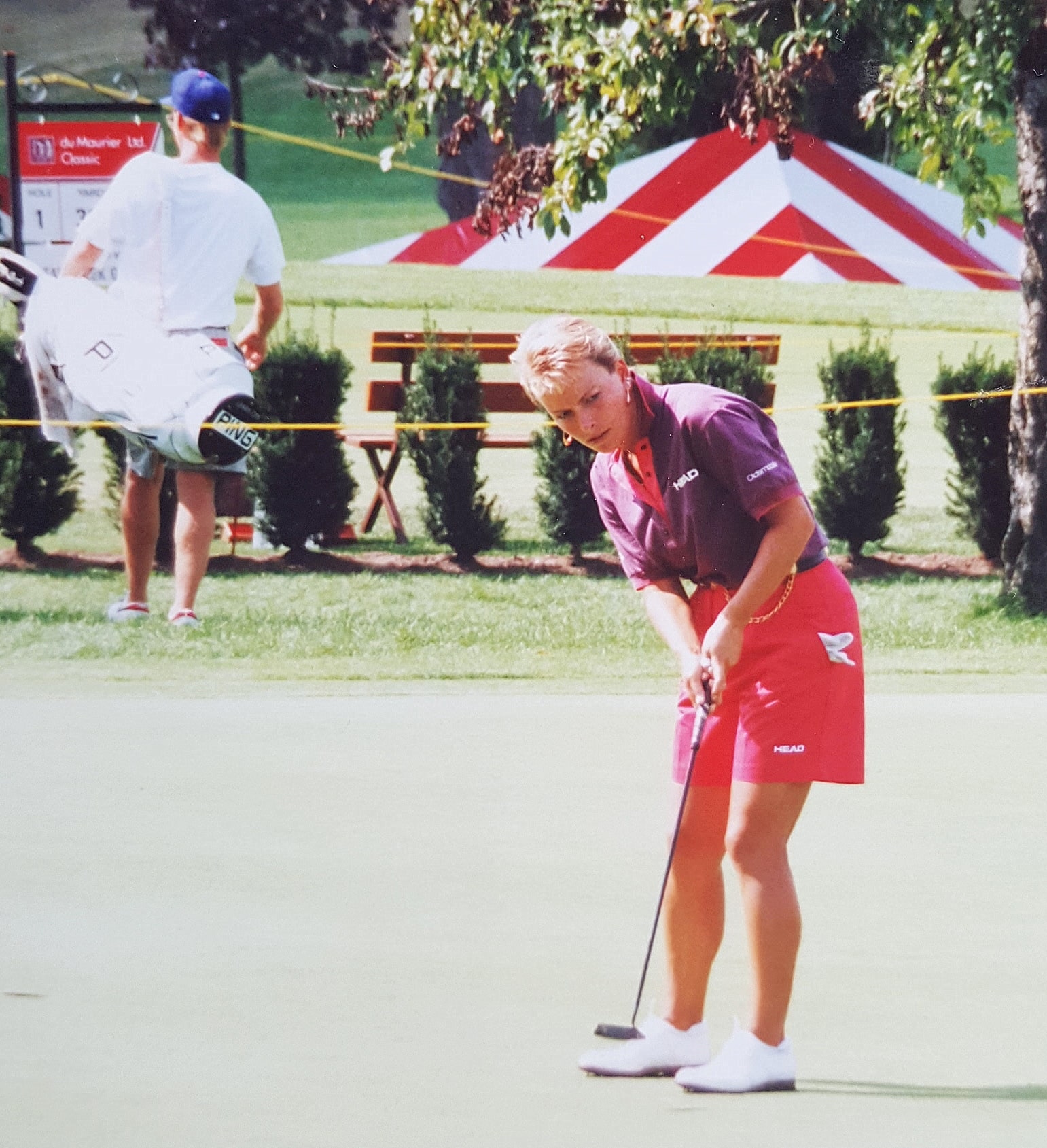
American Dottie Pepper, now a golf analyst with The Golf Channel, was in the field at the 1993 du Maurier Ltd. Classic at London Hunt. Photo: Jeffrey Reed/LondonOntarioSports.com.
When you talk about big-time golf tournaments in London, none compare to the Holy Grail – the 1993 du Maurier Ltd. Classic, captured by Brandie Burton in a playoff versus fellow American Betsy King. Canadian Dawn Coe-Jones fought hard but finished third. Who can forget that week? It was one of the hottest and muggiest on record, with a torrential downpour during championship Sunday – but the women played on and provided a week-long gallery of 65,000 fans with world-class golf. This was a very different London – more innocent, smaller at 383,000 (a number that was then recently inflated via annexation) and more willing to embrace a major golf tournament: it was a big deal for London. As usual, London Hunt, Golf Canada and everyone involved in hosting this event was spot-on with their efforts. I enjoyed lunch with Jocelyne Bourrasa that week and golfed in a media day pro-am while reporting for numerous publications including SCORE Golf. The large media tent, parked on the front lawn of the historic golf club, was so packed there was barely any elbow room – thanks to a large contingent from the Toronto media. Remember: this we pre-Internet, pre-social media. To this day, the ’93 du Maurier Ltd. Classic is the best and most successful golf tournament ever held in the Forest City. Period.
Let’s not forget the 2006 CN Canadian Women’s Open, though, again contested at – where else? – London Hunt. American Cristie Kerr trailed leader and fellow American Angela Stanford by eight strokes heading into the final round, but won by a stroke when Stanford faltered and eventually three-putted the final hole. This event also attracted an estimated 65,000 fans – a huge achievement given the fact London was, indeed, changing: Londoners prefer to do things – bike, boat, travel – rather than stand around at a golf tournament for an entire week. We were becoming more Toronto-like: only big names interested us now, and the ’06 CN Canadian Women’s Open was on the fringe of that interest – big names, but not as star-studded as the ’93 tournament. Or so it seemed. Things would soon change, though. But let’s not sell short the fact that this event, and every other golf tournament of note held in London, has, combined, help raise millions of dollars for local charities. That’s what counts – not an oversized cheque on the 18th green come Sunday, nor the size of the gallery, as I’ll get into.

So Yeon Ryu lines up a putt at London Hunt’s 18th hole en route to victory at the 2014 CP Women’s Open. Photo: Jeffrey Reed/LondonOntarioGolf.com.
Kerr, by the way, said of London Hunt, it’s “a beautiful golf course. It’s tree lined, dog legged, fast greens. It definitely does play like a major course to me. I remember the crowds, and the momentum I had on Sunday. It was a really special experience for me. Of all the courses in Canada, I actually still think that London Hunt Club is my favourite – the setup, how the full of the course builds, different holes. No two holes are alike. And it keeps you very interested.”
London really was the Golf Capital of Canada in 2014 when the newly-sponsored CP Women’s Open played at London Hunt, FireRock Golf Club hosted the PGA Women’s Championship of Canada, captured by a 16-year-old Brooke Henderson, and the second year of the PGA Tour Canada season-ending championship was contested at Sunningdale.
The Gallery Disaster Of 2014
But something went terribly wrong with the 2014 CP Women’s Open gallery. This is not a knock against Golf Canada nor the LPGA Tour. This was a London issue: for whatever reason, the LPGA Tour was no longer a huge draw – only 16,500 fans attended that week. The huge media tent erected on the London Hunt lawn could have been a garden shed, given the fact only a handful of reporters – yours truly included – attended the entire week as working members of the golf media. Others popped in and out, mostly on championship Sunday, but this was a pale comparison to 2006 and especially 1993. I felt terrible for Golf Canada’s media director Dan Pino, and we even had words later that year at Sunningdale after my column ran with LPGA Tour officials telling me it was their “worst tournament of the year.” They meant, of course, the worst gallery. Golf Canada’s then-CEO Scott Simmons met with me during breakfast on championship Sunday and asked, with great concern, “What has happened to London? What has changed?” He was, like all of us, surprised at the lack of fans in attendance. I told Simmons, Londoners are a funny bunch, and were no longer in awe of LPGA Tour stars – not at that time, anyway. The event was not a big draw. Period. The lack of media on site was a big surprise to me, though – and let me say, walking the grounds on Sunday and kissing ass in order to secure a free round of golf does not make you a working member of the golf media. The late Ian Hutchinson, a mentor, my editor at SCORE Golf and colleague, and my best friend amongst fellow golf media, agreed with me and spoke with me many times about this topic. It angered him, too. We both spent entire weeks at LPGA Tour golf tournaments as working journalists when most of our fellow scribes and broadcasters chose not to attend. Like me, Hutch understood how golf media were a dying breed. Anyhow, yet another topic for another column.
The golf that week in 2014 at London Hunt, though, was amazing. So Yeon Ryu, 24, of South Korea set the course record in her first round, held a four-stroke advantage going into Sunday and led by six going into the back nine before finally shooting a 23-under 265 for the win and $337,500 prize.
Golf Canada still has the post-round news conference online – I was able to get in the first two questions for the winner, beginning at 3:24 of the video here .
The 2014 PGA Women’s Championship of Canada was more of a family and friends-attended event, and that was too bad given the terrific golf played by Henderson, now the best golfer to ever come out of Canada. Period. Sorry, Weir. As for the PGA Tour Canada event, held in London at Sunningdale in 2013 and ’14, and at Highland Country Club from 2015 to ’19, let me weigh in on that shit show. Again, the charity aspect of the tournament was the event’s legacy – but so is the fact so many things went wrong that should not have.
First, let me way, this event was never going to draw galleries. Not a chance in hell. Watch any Korn Ferry Tour event – hell, watch most LPGA Tour events and even a few PGA Tour stops – and you could shoot a cannon along the ropes and hit no one. Thus, this tournament, held in London for seven years, had no chance of being a tourist draw nor a substantial revenue generator. The sad thing is, the host clubs thought otherwise. Wrong.
A Golf Case Study

(L-R) Taylor Pendrith, C.T. Pan, 2025 U.S. Open champ J.J. Spaun, Sam Ryder, tournament winner Jason Millard – the Fab Five graduating from the Mackenzie Tour PGA Tour Canada to the PGA Tour at the 2015 Freedom 55 Financial Championship at Highland Country Club. Photo: Jeffrey Reed/LondonOntarioGolf.com.
When PGA Tour Canada – later the Mackenzie Tour PGA Tour Canada, and now part of PGA Tour Americas – brought its season-ending championship to London in 2013, it was the talk of the town. But when the Mackenzie Tour released its 2021 schedule – minus the Highland Country Club-hosted Canada Life Championship – only LondonOntarioSports.com reported on the fact, Highland and Canada Life were no longer part of the Mackenzie Tour. One media outlet reported on this. Me. I stand by my word: the rest of the local media have no excuse. I respect my fellow journalists, including the rest of the Canadian golf media, but they missed the boat on this one.
Perhaps that’s a tell-tale sign that, in the end, few in our community cared about the Mackenzie Tour’s flagship event. That’s not to say the season-ending championship at Highland CC was a complete flop. In fact, minus dismal attendance, it left a lasting legacy in terms of promoting the game and supporting local charities.
But during tournament week at Highland from 2015 to 2019, and at Sunningdale in 2013 and 2014, horrible attendance was always the elephant in the room – rather, on the golf course. Everyone knew this was more of a family and friends-attended event, but no one talked about it – other than the avid golf fans in attendance, who wondered where everyone was. Notable local golf industry members – for four years – stopped to chat with me at Highland as they scratched their head when trying to figure out why attendance was absolutely horrible. And in the end, tiny galleries at Highland were at least part of the reason why Canada Life pulled its sponsorship of the Canada Life Championship. Any way you look at it, this is a classic case of not knowing what you’ve got until you lose it.
To this day, the removal of that tournament from the local golf calendar leaves an empty hole. Why? The season-ending championship had called London its permanent home. That doesn’t happen very often in the nomadic golf world. But now it’s gone for good.
The seven-year run of the Tour Championship of Canada/Freedom 55 Financial Championship, which became the Canada Life Championship beginning in 2018, represented a solid run for this tournament. Without the COVID-19 pandemic cancelling the 2020 tournament, it would have had a respectable eight-year run in the Forest City.
But according to former PGA Tour Canada executive director Scott Pritchard, now One Eleven Management Group vice-president and partner, title sponsorship and host clubs are both cyclical by nature.
“Events have a life span, and so, too, does sponsorship,” Pritchard said in a 2021 interview with LondonOntarioSports.com. “We’ve known for some time that Canada Life was not going to renew our agreements in London and Vancouver (host of the now-defunct Canada Life Open). They wanted to move in a different direction, and we saw that (with the naming of the Canada Life Centre, home of the Winnipeg Jets).”
Without a title sponsor – one which continuously emphasized the fact they wanted the event in London, home to its corporate headquarters, and at Highland CC – the writing was on the wall for Highland, according to Pritchard. He said Highland “has been a great partner, but ultimately, sponsorship drives our events, and you need a title sponsor – in addition to significant sponsors – to ensure financial success of your event. We weren’t able to secure a replacement for London at this time.”

Vancouver, B.C.’s Ryan Williams blasting out of the No. 9 bunker at the 2015 Mackenzie Tour PGA Tour Canada Freedom 55 Financial Championship at Highland Country Club. Williams won the 2014 event at Sunningdale Golf and Country Club, then lost in a playoff to Jason Millard at Highland. Photo: Jeffrey Reed/LondonOntarioGolf.com.
The 2013 and 2014 tournaments at Sunningdale were hammered by cold, wet weather and galleries at times measured less than 100 fans, even on championship Sunday. The Sunningdale membership did not embrace the tournament, either – but to their credit, more Highland members than Sunningdale members welcomed the tournament with open arms. Still, not all Highland members were on board. Some consider it a tragedy to lose their golf course for a week. That’s the snobby, entitled portion of golf, and those people will never disappear.
Despite perfect weather on almost every tournament day at Highland from 2015 through 2019, Londoners stayed away from this event. Sunday galleries measured about 800 in 2015, 1,400 in 2016, 1,000 in 2017, then only about 500 during the final two years of the championship. Thursday-Friday-Saturday rounds resembled more family and friends events than a professional golf tournament.
And while you can’t measure the true success of a Mackenzie Tour tournament by the size of its gallery, Pritchard did hint that lack of attendance did weigh on the minds of Canada Life like a large elephant. “Having fans there or not isn’t going to make or break a tournament,” Prichard said. “That being said, had the community embraced the event, and had scores of people come out, then certainly it would have been hard for a sponsor to say, ‘We won’t continue.’”
Pritchard said during every single meeting with the Highland tournament committee, attendance was discussed. But he said Highland – which assumed many of the tournament responsibilities previously handled by Golf Canada from 2013 through 2016 – as well as the Mackenzie Tour could not “crack the code in London in terms of getting fans out. It just never happened. I would say we had core golf fans at Highland, but that’s it. The (London) market looked at the event as a Highland event, rather than a community event.”
The tournament at Sunningdale and Highland may have hosted the stars of tomorrow, but Londoners only want to see the stars of today.
There have been highly-successful golf tournaments in London that did not draw large crowds – they include the London Hunt-hosted 2010 Canadian Men’s Amateur Championship, and the Canadian Tour’s Ontario Open at Forest City National Golf Club in 1994 and ’95, all of which I attended. Most recently, West Haven G&CC did a great job in hosting the 109th Ontario Women’s Amateur in 2024 – minus the absolute horrendous job from Golf Ontario with media relations that week.
Golf: The Good, the Bad & The Ugly

With my 2024 Milestone Award, which reads, “In recognition of your continued dedication to London and Area sports, and support of the Southwestern Ontario golf community.” City of London Parks and Recreation, on behalf of family, friends and colleagues, presented this award to me, and I’m extremely proud of this honour. It means a lot.
As you can tell, golf is in my blood. It helps define who I am. Most of my life, I have dedicated my efforts on and off the golf course to promoting what I believe is the greatest game of all. In fact, since my 2019 injury which ended my days as a golfer, I’ve fallen more in love with the game than I did when I was playing to a plus-handicap index, practicing until my hands bled and golfing most of the week.
But like every other part of our lives, golf has its blemishes. As a veteran sports journalist, I can tell you that just like every other sport, golf has its share of morons – from touring pros to local club management.
In my May 2021 column, I wrote about retiring from the links – an emotional yet necessary decision. In that piece, I recounted how I have been bullied as a golf journalist – in person and online, by some of the biggest names in Canadian golf, no less – and, concurrently, as a disabled person: that’s right, some of the biggest names in Canadian golf have doubted my disabilities. And that is disgusting. I’ll save them further embarrassment by not naming them, but you can read that column here.
Professional touring golfers, by the way, are the most cerebral of all athletes I’ve dealt with for parts of six decades, and that is a breath of fresh air. I’ve spent a lot of time in Major League Baseball clubhouses and NHL locker rooms, and believe me, golfers by far are the most intelligent. But I’ve been treated horribly by players on both the PGA Tour and LPGA Tour – there’s yet another topic for a column. Yes, I’ve even butted heads with Weir, Canada’s golden boy of golf (it blew over and we have spoken on friendly terms long since, and presented him with the Heart Award in 2014). Yet the vast majority of anyone within the golf family have been and continue to be a joy to work with, on and off the course. Believe me when I say that – and I do so not seeking free golf equipment nor complimentary rounds at the local country club.
Here’s an odd story. A few years ago, while interviewing a top Canadian golf executive, this person – in the most condescending tone – said, “I see you focus on local golf news. Why? You know, if you ever need help with stories on a larger scale, then I’m sure some of your colleagues (meaning other Canadian golf writers) could help you out with that. Don’t be afraid to ask.” I sat there, puzzled, laughing and cursing this idiot inside. Of course, I have always written about golf on a gobal scale – and continue to do so for print, this website and occasionally radio and TV. And, my byline has appeared, over the years, in every national newspaper chain, countless magazines and, for a long tenure, in both SCORE Golf and Ontario Golf magazines, not to mention publications produced by that same person’s golf association. Either this person didn’t know (and therefore should not have made that assumption) or didn’t care.
Golf is a great game, but it’s not immune to asses. On that note, one remark I hear a lot from non-golfers is that country clubs are the bastion of snobbery. In fact, they’re wrong. Over the course of my long career, I’ve been treated very well while a guest at some of the ‘snobbiest’ country clubs in Canada, yet have been treated like shit at the dumpiest public tracks in Southwestern Ontario. And why shouldn’t a country club uphold standards? More power to them.
In the end, golfers are part of a large family. Unlike other sports, if you are a weekend warrior or a country club member who cherishes your time on the course, then you feel connected to even the most decorated of golfers. If you’re a golfer, then you get it: when you’re playing a round with your foursome, and then watch a round of PGA Tour or LPGA Tour golf on the tube at the 19th hole grille, you somehow feel connected. You have a common bond in golf. And it’s not just a bond with a sport; in fact, golf is a game of honesty, integrity and sportsmanship – traits which would better the world today if we were all to inherit those characters.

Jeffrey Reed and the late Ian Hutchinson of Golf News Now covering the 2012 RBC Canadian Open at Hamilton G&CC.
What has changed most about golf? It doesn’t take itself as seriously as it has in the past – and that is a very good thing. Ian Hutchinson and I enjoyed many talks about how golf needs to chill – shed the negative elements of its country club persona, yet still maintain all that is good about the game. I’ve spoken with nationally-published sportswriters who, without hesitation, have expressed their own self-professed “hatred” of the game because of its “snobby, exclusive” ways.
Take a good look around any golf course – public links and country clubs included. Golf has changed. It more closely mirrors the real world. And that means the game is in a very good place.
When I die, I’ll be put in a box holding a golf club. That’s how I feel about golf. And after reading this column, then perhaps you’ll acknowledge that I’m not alone.
I’m glad I wrote this column – I’ve said things that my friend, Ian Hutchison and I, spoke about for years. And I know there are others who agree with many of my thoughts in this column.
In ending, let me say, every sport has its problems. Yet golf is the greatest game, because of its life lessons taught and the people you connect with throughout your lifetime.
–30–
Award-winning writer and broadcaster Jeffrey Reed has covered sports in Southwestern Ontario and at the provincial and national level since 1979. A three-time author, Reed penned the 2018-published book, The Canadian Seniors’ Golf Association, Celebrating 100 Years of Canadian Golf 1918-2018. On The Record with Jeffrey Reed appears weekly at LondonOntarioSports.com. Reach Jeffrey at jeff@londonontariosports.com.